
Are you Ready to Be Found in the AI-Powered Search Era? The way customers discover and connect with businesses is being completely rewritten by artificial intelligence. Traditional search is giving way to AI-driven discovery where algorithms, conversational engines, and predictive systems decide what people see first. If your brand isn’t adapting, it’s already falling behind.
AI is transforming not just what people search for, but how they search. Consumers now turn to intelligent assistants for instant, personalized answers instead of scrolling through endless results. The question is, has your business evolved with them?
To stay visible and relevant, your marketing strategy must align with the AI-powered ecosystem. Start by focusing on three core areas:
Everything about discovery is changing. Staying ahead means preparing your brand to be found not by search engines of the past, but by the intelligent systems shaping the future.
Traditional marketing was built on pushing content to audiences through familiar channels email, ads, and search. But the AI-driven era is flipping that model into a pull ecosystem, where users discover brands, products, and services organically through AI-powered environments. Marketers can no longer rely solely on controlling the message; instead, they must learn to influence. The AI systems that curate and personalize narratives for each user in real time.
Embracing this new reality leads to stronger, more agile digital strategies, richer user interactions, and a competitive edge in AI-powered discovery.
Your brand might be a true authority in its field, but will your content still appear when users turn to AI engines instead of traditional search? The landscape has already shifted, and there’s no turning back. Artificial intelligence now delivers instant, summarized insights directly to users, often without them ever visiting your website. This means you have far less control over what’s being said about your brand, and, in some cases, AI may even generate inaccurate or “hallucinated” information.
To stay visible and credible, your website must be fully optimized to appear in AI-generated answers. Ensure your content structure, metadata, and authority signals are strong enough to make AI engines recognize and trust your brand. Now is the time to adopt best practices that help you surface for relevant questions and capture high-intent traffic in this new era of intelligent discovery.
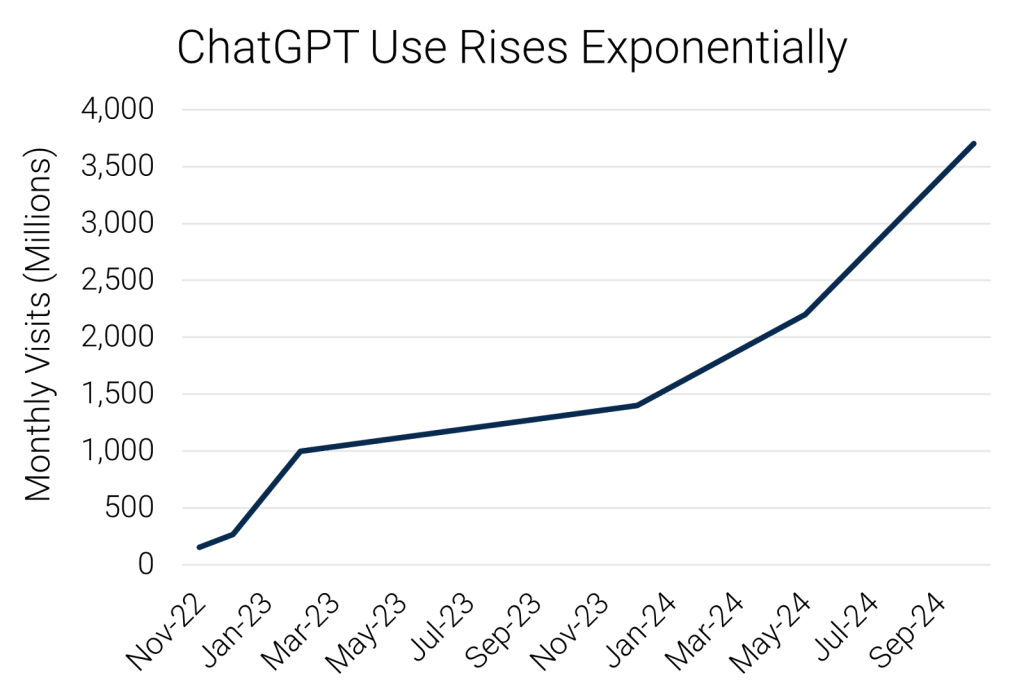
The search landscape is evolving faster than ever. People no longer rely solely on typing keywords into Google they’re turning to AI platforms for research and discovery. With AI tools like ChatGPT, Perplexity, Apple Intelligence, and Gemini, users can now gather comprehensive insights from a single source rather than jumping between multiple sites. This shift is already transforming how brands are found online. In fact, according to Similarweb data from 2024, ChatGPT recorded over 3.7 billion global visits in October alone, while Perplexity attracted nearly 91 million, underscoring how rapidly AI is becoming the new front door to the internet.
To stay competitive, brands must rebuild their foundation for AI visibility that means structuring data clearly, producing relevant, trustworthy content, and following EEAT principles (Experience, Expertise, Authoritativeness, and Trustworthiness). Start by revisiting your content strategy: make original research and high-value insights easily discoverable. Even if they’re no longer hidden behind gated forms.
Also, rethink your performance metrics. As “zero-click” searches rise, visibility within AI summaries may matter more than direct website traffic users might learn about your brand without ever visiting your site.
Finally, expand your focus beyond Google. The AI-powered search era spans across multiple ecosystems, and marketing teams. That can pivot quickly adjusting strategies and optimizing for AI-first discovery will be the ones who thrive.
Make your site the obvious answer in Google and AI tools like Perplexity and ChatGPT. Proximate Solutions will audit your site and deliver a simple plan you can act on immediately.
What you get (no cost, no commitment):

The rapid evolution of how people discover information online has created major uncertainty for organizations. The truth is no one can accurately predict how organic traffic will shift as AI-driven search continues to dominate. What worked before with traditional SEO investments may no longer deliver the same results. While organic visits might decline, other digital marketing channels could begin to show stronger conversion performance reshaping how success is measured.
Executives now face the challenge of navigating this unpredictability unsure how these changes will affect their digital performance or if revenue goals will still be met. Adding to the complexity, large language models (LLMs) like ChatGPT or Gemini can sometimes “hallucinate,” offering incorrect information or omitting your brand entirely from AI-generated responses.
For many companies, this rapidly changing AI environment feels disorienting. New models appear unpredictably, and it’s impossible to know which platforms users will trust next. With a multigenerational workforce, individuals also engage with AI in vastly different ways making it harder to craft a unified strategy.
Many organizations have been Google-centric for years and now struggle to adapt to new platforms like Perplexity or Bing’s AI ecosystem, which powers ChatGPT and Microsoft Copilot. Limited technical resources and slow internal processes. Further hinder the ability to update digital assets and move fast enough to stay competitive.
At Proximate Solutions, we emphasize getting back to digital best practices. The foundations that make your brand discoverable and credible in the age of AI. That means using structured data, producing original and regularly updated content. Also optimizing assets to ensure your business is included in AI-generated answers.
Our step-by-step framework helps organizations audit, adapt, and future-proof their online presence so that as AI reshapes discovery. Your brand remains part of the conversation, not lost in the noise.
Artificial intelligence is completely transforming the way people search for and engage with digital content. Instead of visiting multiple websites through traditional search engines, users are now turning to AI-powered large language models (LLMs) like ChatGPT and Perplexity to gather information, compare options, and make decisions all within a single platform. This marks a fundamental change in online behavior that businesses can no longer afford to ignore.
Recent data highlights this massive shift. ChatGPT alone recorded over 3.7 billion visits by late 2024, showing exponential growth since its launch. This surge reflects how quickly consumers are embracing AI as their go-to research tool, replacing the fragmented browsing experience with a seamless, AI-curated discovery process.
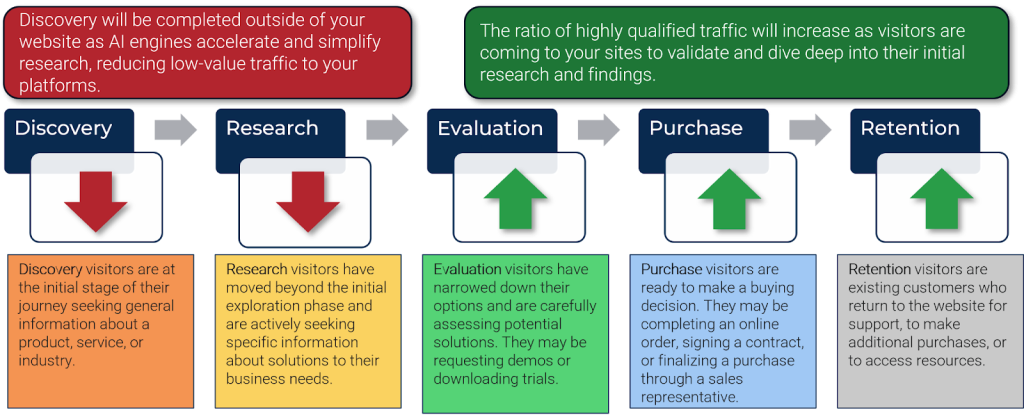
AI has rewritten the customer journey. The discovery and research phases once a key source of website traffic are increasingly happening outside your domain. AI search engines now summarize and synthesize information before users ever visit a brand’s site. As a result, low-intent traffic may decline, but the visitors who do reach your pages will likely be more qualified and conversion-ready.
Success in this new landscape can’t be measured by organic traffic alone. With Google’s AI Overview projected to reduce organic visits by 18% to 64%, brands must shift focus from volume to value. Even if traffic drops, conversion rates may rise as users arriving from AI-driven searches are further along in their decision process.
The digital landscape isn’t just evolving it’s being redefine by AI. Search is no longer about keywords and clicks; it’s about context, conversation, and credibility. As AI-driven engines reshape how people discover and evaluate brands, traditional SEO alone can no longer guarantee visibility. To stay relevant, your brand must shift toward AI-first optimization where your content is structured, trusted, and discoverable by intelligent systems.
That’s where Proximate Solutions leads the way. Our AI Search Audit goes beyond surface-level insights to analyze how your brand appears across AI platforms. To identify weak points in your content strategy. And create a clear path toward visibility in AI-generated results. Don’t wait for the shift contact us today to future-proof your presence today with Proximate Solutions and be discovered where the next generation of customers are searching.
1- What does the transition to AI-driven search models mean for brand discoverability?
The paradigm shift in search engines focuses on moving from traditional indexes of web links to synthesized, conversational answers. Consequently, a brand’s strategic objective shifts from earning a standard numerical ranking to becoming the primary trusted entity cited within the AI’s response.
2- How can organizations safeguard their brand reputation within AI-generated answers?
Data consistency across the digital ecosystem is paramount. Ensure all organizational messaging, core offerings, and corporate data are uniform across your primary website, social channels, and public directories, as AI models validate truth through multi-source cross-verification.
3- Will the expansion of AI search models lead to a decline in organic web traffic?
Traffic patterns will shift. While informational queries may yield fewer aggregate clicks, the traffic routed through AI citations demonstrates significantly higher intent; these users have already interacted with an AI recommendation and are further down the acquisition funnel.
4- What constitutes “Brand Authority” within algorithmic models?
AI architectures evaluate authority through established E-E-A-T principles (Experience, Expertise, Authoritativeness, and Trustworthiness). Publishing proprietary research, deep-dive case studies, and distinct expert commentary signals to AI models that your brand is a definitive industry leader.
5- Is it necessary to restructure keyword strategies to accommodate AI search engines?
Yes. Optimization must evolve beyond rigid, short-tail keywords toward entity-based optimization and natural language processing (NLP). Content should be structured around specific problem-solving frameworks, mirroring the conversational syntax consumers naturally use.
6- By what mechanisms do large language models extract knowledge about a brand?
AI models ingest your native web content while simultaneously evaluating off-page signals, including digital PR coverage, high-authority guest contributions, and organic industry forum discussions. A robust digital public relations footprint is now an essential element of modern search visibility.
7- Can an organization restrict AI search engines from indexing its digital assets?
While brands can technically block specific AI crawlers utilizing standard robots.txt directives, doing so is generally counterproductive to digital marketing goals. Exclusion effectively removes your brand from the conversational search touchpoints where consumer behavior is rapidly consolidating.
Are you Ready to Be Found in the AI-Powered Search Era? The way customers discover and connect with businesses is being completely rewritten by artificial intelligence. Traditional search is giving way to AI-driven discovery where algorithms, conversational engines, and predictive systems decide what people see first. If your brand isn’t adapting, it’s already falling behind.
AI is transforming not just what people search for, but how they search. Consumers now turn to intelligent assistants for instant, personalized answers instead of scrolling through endless results. The question is, has your business evolved with them?
To stay visible and relevant, your marketing strategy must align with the AI-powered ecosystem. Start by focusing on three core areas:
Everything about discovery is changing. Staying ahead means preparing your brand to be found not by search engines of the past, but by the intelligent systems shaping the future.
Traditional marketing was built on pushing content to audiences through familiar channels email, ads, and search. But the AI-driven era is flipping that model into a pull ecosystem, where users discover brands, products, and services organically through AI-powered environments. Marketers can no longer rely solely on controlling the message; instead, they must learn to influence. The AI systems that curate and personalize narratives for each user in real time.
Embracing this new reality leads to stronger, more agile digital strategies, richer user interactions, and a competitive edge in AI-powered discovery.
Your brand might be a true authority in its field, but will your content still appear when users turn to AI engines instead of traditional search? The landscape has already shifted, and there’s no turning back. Artificial intelligence now delivers instant, summarized insights directly to users, often without them ever visiting your website. This means you have far less control over what’s being said about your brand, and, in some cases, AI may even generate inaccurate or “hallucinated” information.
To stay visible and credible, your website must be fully optimized to appear in AI-generated answers. Ensure your content structure, metadata, and authority signals are strong enough to make AI engines recognize and trust your brand. Now is the time to adopt best practices that help you surface for relevant questions and capture high-intent traffic in this new era of intelligent discovery.
The search landscape is evolving faster than ever. People no longer rely solely on typing keywords into Google they’re turning to AI platforms for research and discovery. With AI tools like ChatGPT, Perplexity, Apple Intelligence, and Gemini, users can now gather comprehensive insights from a single source rather than jumping between multiple sites. This shift is already transforming how brands are found online. In fact, according to Similarweb data from 2024, ChatGPT recorded over 3.7 billion global visits in October alone, while Perplexity attracted nearly 91 million, underscoring how rapidly AI is becoming the new front door to the internet.
To stay competitive, brands must rebuild their foundation for AI visibility that means structuring data clearly, producing relevant, trustworthy content, and following EEAT principles (Experience, Expertise, Authoritativeness, and Trustworthiness). Start by revisiting your content strategy: make original research and high-value insights easily discoverable. Even if they’re no longer hidden behind gated forms.
Also, rethink your performance metrics. As “zero-click” searches rise, visibility within AI summaries may matter more than direct website traffic users might learn about your brand without ever visiting your site.
Finally, expand your focus beyond Google. The AI-powered search era spans across multiple ecosystems, and marketing teams. That can pivot quickly adjusting strategies and optimizing for AI-first discovery will be the ones who thrive.
Make your site the obvious answer in Google and AI tools like Perplexity and ChatGPT. Proximate Solutions will audit your site and deliver a simple plan you can act on immediately.
What you get (no cost, no commitment):
The rapid evolution of how people discover information online has created major uncertainty for organizations. The truth is no one can accurately predict how organic traffic will shift as AI-driven search continues to dominate. What worked before with traditional SEO investments may no longer deliver the same results. While organic visits might decline, other digital marketing channels could begin to show stronger conversion performance reshaping how success is measured.
Executives now face the challenge of navigating this unpredictability unsure how these changes will affect their digital performance or if revenue goals will still be met. Adding to the complexity, large language models (LLMs) like ChatGPT or Gemini can sometimes “hallucinate,” offering incorrect information or omitting your brand entirely from AI-generated responses.
For many companies, this rapidly changing AI environment feels disorienting. New models appear unpredictably, and it’s impossible to know which platforms users will trust next. With a multigenerational workforce, individuals also engage with AI in vastly different ways making it harder to craft a unified strategy.
Many organizations have been Google-centric for years and now struggle to adapt to new platforms like Perplexity or Bing’s AI ecosystem, which powers ChatGPT and Microsoft Copilot. Limited technical resources and slow internal processes. Further hinder the ability to update digital assets and move fast enough to stay competitive.
At Proximate Solutions, we emphasize getting back to digital best practices. The foundations that make your brand discoverable and credible in the age of AI. That means using structured data, producing original and regularly updated content. Also optimizing assets to ensure your business is included in AI-generated answers.
Our step-by-step framework helps organizations audit, adapt, and future-proof their online presence so that as AI reshapes discovery. Your brand remains part of the conversation, not lost in the noise.
Artificial intelligence is completely transforming the way people search for and engage with digital content. Instead of visiting multiple websites through traditional search engines, users are now turning to AI-powered large language models (LLMs) like ChatGPT and Perplexity to gather information, compare options, and make decisions all within a single platform. This marks a fundamental change in online behavior that businesses can no longer afford to ignore.
Recent data highlights this massive shift. ChatGPT alone recorded over 3.7 billion visits by late 2024, showing exponential growth since its launch. This surge reflects how quickly consumers are embracing AI as their go-to research tool, replacing the fragmented browsing experience with a seamless, AI-curated discovery process.
AI has rewritten the customer journey. The discovery and research phases once a key source of website traffic are increasingly happening outside your domain. AI search engines now summarize and synthesize information before users ever visit a brand’s site. As a result, low-intent traffic may decline, but the visitors who do reach your pages will likely be more qualified and conversion-ready.
Success in this new landscape can’t be measured by organic traffic alone. With Google’s AI Overview projected to reduce organic visits by 18% to 64%, brands must shift focus from volume to value. Even if traffic drops, conversion rates may rise as users arriving from AI-driven searches are further along in their decision process.
The digital landscape isn’t just evolving it’s being redefine by AI. Search is no longer about keywords and clicks; it’s about context, conversation, and credibility. As AI-driven engines reshape how people discover and evaluate brands, traditional SEO alone can no longer guarantee visibility. To stay relevant, your brand must shift toward AI-first optimization where your content is structured, trusted, and discoverable by intelligent systems.
That’s where Proximate Solutions leads the way. Our AI Search Audit goes beyond surface-level insights to analyze how your brand appears across AI platforms. To identify weak points in your content strategy. And create a clear path toward visibility in AI-generated results. Don’t wait for the shift contact us today to future-proof your presence today with Proximate Solutions and be discovered where the next generation of customers are searching.
1- What does the transition to AI-driven search models mean for brand discoverability?
The paradigm shift in search engines focuses on moving from traditional indexes of web links to synthesized, conversational answers. Consequently, a brand’s strategic objective shifts from earning a standard numerical ranking to becoming the primary trusted entity cited within the AI’s response.
2- How can organizations safeguard their brand reputation within AI-generated answers?
Data consistency across the digital ecosystem is paramount. Ensure all organizational messaging, core offerings, and corporate data are uniform across your primary website, social channels, and public directories, as AI models validate truth through multi-source cross-verification.
3- Will the expansion of AI search models lead to a decline in organic web traffic?
Traffic patterns will shift. While informational queries may yield fewer aggregate clicks, the traffic routed through AI citations demonstrates significantly higher intent; these users have already interacted with an AI recommendation and are further down the acquisition funnel.
4- What constitutes “Brand Authority” within algorithmic models?
AI architectures evaluate authority through established E-E-A-T principles (Experience, Expertise, Authoritativeness, and Trustworthiness). Publishing proprietary research, deep-dive case studies, and distinct expert commentary signals to AI models that your brand is a definitive industry leader.
5- Is it necessary to restructure keyword strategies to accommodate AI search engines?
Yes. Optimization must evolve beyond rigid, short-tail keywords toward entity-based optimization and natural language processing (NLP). Content should be structured around specific problem-solving frameworks, mirroring the conversational syntax consumers naturally use.
6- By what mechanisms do large language models extract knowledge about a brand?
AI models ingest your native web content while simultaneously evaluating off-page signals, including digital PR coverage, high-authority guest contributions, and organic industry forum discussions. A robust digital public relations footprint is now an essential element of modern search visibility.
7- Can an organization restrict AI search engines from indexing its digital assets?
While brands can technically block specific AI crawlers utilizing standard robots.txt directives, doing so is generally counterproductive to digital marketing goals. Exclusion effectively removes your brand from the conversational search touchpoints where consumer behavior is rapidly consolidating.