
Half the Internet Has Moved to AI Search. Has Your Marketing Strategy Followed? If not, then you might be missing something huge. Here is the reason why is it so
Still wondering when artificial intelligence will truly transform how people search, research, and discover online? That moment has already arrived. Just as social media once revolutionized how consumers explored and bought products, AI-powered search is now taking center stage. From ChatGPT, Gemini, Copilot, Perplexity, and Claude to Google’s AI Overview, users are increasingly relying on these intelligent engines to guide purchase decisions, compare brands, and uncover new options they might never have found through traditional search.
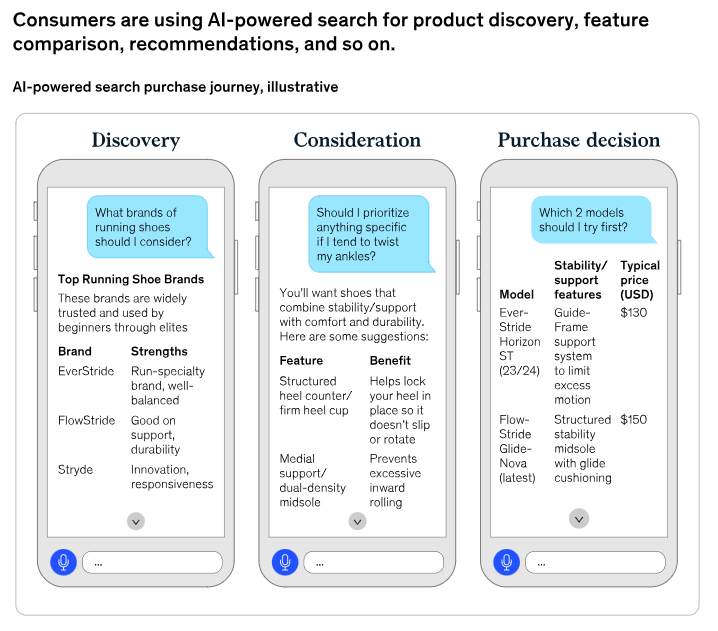
To illustrate, imagine a shopper researching the best brands for cross-training shoes. Instead of scrolling through endless web pages or review sites, AI-powered search engines now provide personalized insights instantly. These tools can explain which factors matter most—such as price, performance, comfort, and style and highlight which brands excel in specific features. They also identify top-rated models based on real user feedback. Even better, consumers can refine results by adding personal details, like their fitness goals or spending limit, allowing AI systems to deliver tailored recommendations that feel uniquely aligned with their needs.
Recent analyses reveal how deep this transformation runs. Around 50% of Google searches now feature AI-generated summaries, and that share is expected to climb beyond 75% by 2028. According to a McKinsey survey, half of all consumers actively choose AI-driven search platforms, with most considering them their primary digital tool for making buying decisions. Adoption isn’t limited to younger audiences’ older generations, including baby boomers, are also rapidly embracing AI-based discovery. By 2028, an estimated $750 billion in U.S. revenue will flow through AI-powered search channels.
This massive behavioral shift means brands that fail to adapt could see their website traffic drop by 20% to 50% as traditional search volumes decline. Even the remaining clicks from legacy search will evolve most will come from better-informed buyers who have already engaged with AI systems earlier in their decision journey.
To stay competitive, forward-looking companies must focus on visibility and reputation across AI summaries and search platforms. That calls for a complete rethinking of digital content and organic strategy shaping messaging, data, and credibility to appeal not only to humans but also to AI systems that aggregate information. While this transition carries some uncertainty, it also offers a powerful opening. Brands that move swiftly, refine their strategy, and adapt to the AI search era can turn disruption into a decisive competitive advantage.
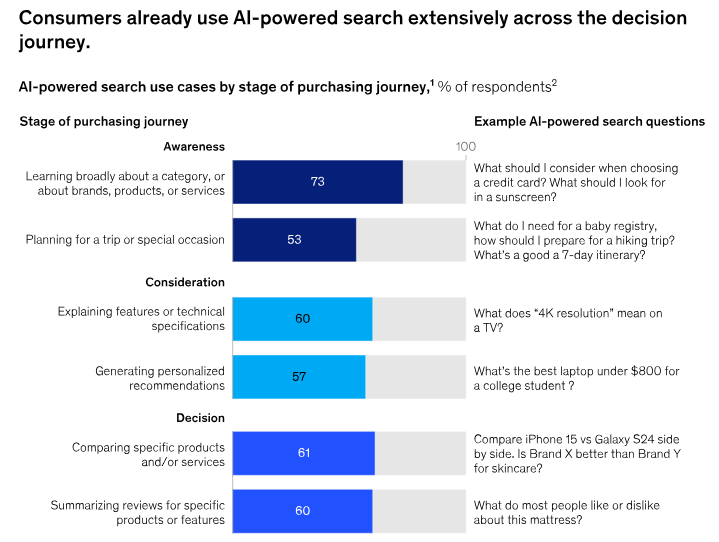
More than 70% of consumers using AI-driven search engage with it at the top of the funnel seeking to learn about a category, brand, product, or service. Yet, the influence of AI doesn’t stop there. These intelligent search tools are now deeply embedded throughout the entire consumer decision journey, shaping choices from initial discovery to final purchase.
To illustrate, imagine a shopper researching the best brands for cross-training shoes. Instead of scrolling through endless web pages or review sites, AI-powered search engines now provide personalized insights instantly. These tools can explain which factors matter most such as price, performance, comfort, and style and highlight which brands excel in specific features. They also identify top-rated models based on real user feedback. Even better, consumers can refine results by adding personal details, like their fitness goals or spending limit, allowing AI systems to deliver tailored recommendations that feel uniquely aligned with their needs
In the traditional search experience, consumers typically had to navigate through a maze of online content before reaching a decision. They would browse multiple review platforms, explore brand websites, sift through category-specific pages, and scan discussion forums to piece together a clear understanding of their options. It was a time-consuming process that demanded effort and interpretation across scattered sources.
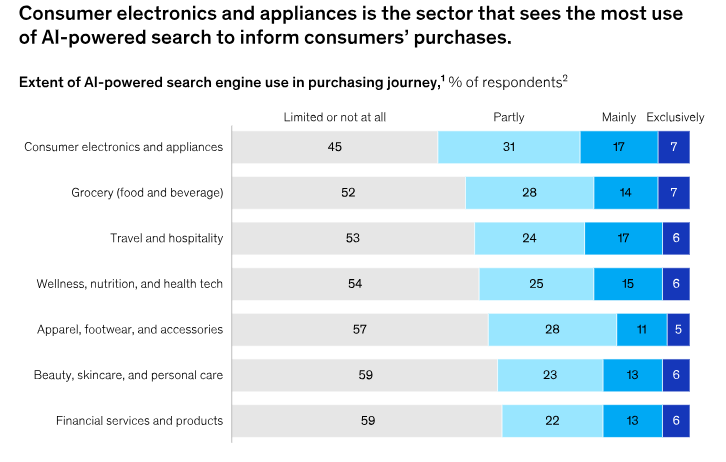
Today, that process is being dramatically simplified. It’s no surprise that between 40% and 55% of consumers across key industries such as consumer electronics, grocery, travel, wellness, apparel, beauty, and financial services now rely on AI-powered search tools to make their purchasing decisions.
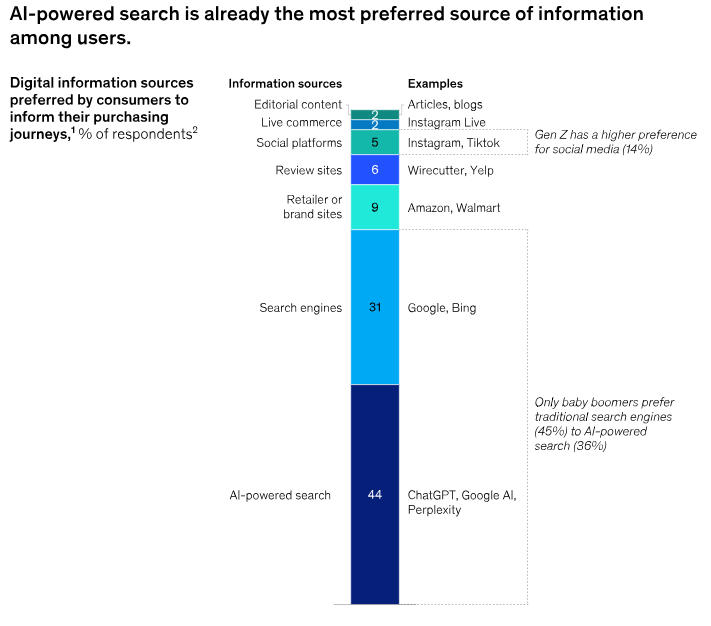
The implications of this transformation are unmistakable. Research shows that 44% of AI-powered search users now identify it as their primary and preferred source of information surpassing traditional search engines (31%), retailer or brand websites (9%), and review platforms (6%).
This shift signals a pivotal moment for marketers. For years, search engine optimization (SEO) has served as the cornerstone of digital visibility. But in the emerging landscape, generative AI engine optimization (GEO) must become an essential pillar of every comprehensive marketing and digital strategy. To remain visible and influential across the evolving web, brands must optimize not only for search engines but also for the AI-driven environments where consumers are now making their decisions.
Even the strongest market leaders aren’t guaranteed visibility in the world of AI-driven search. Traditional SEO strategies primarily optimize a brand’s own website content, but that now represents only a small fraction roughly 5 to 10 percent of the total sources referenced by AI-powered search engines.
Instead, these generative models pull information from a wide range of external sources, including affiliate sites, online reviews, forums, and user-generated content. What’s more, the sources an AI model references vary significantly depending on the large language model (LLM) it uses, as well as the user’s location, the product category, and the specific question asked.
As these LLMs continue to evolve, so will the mix of sources they draw from making it increasingly complex for brands to appear where consumer decisions are actually being shaped. For instance, the distribution of data sources used in AI-generated results already differs dramatically across industries and product categories, creating new challenges for consistent visibility and brand representation.
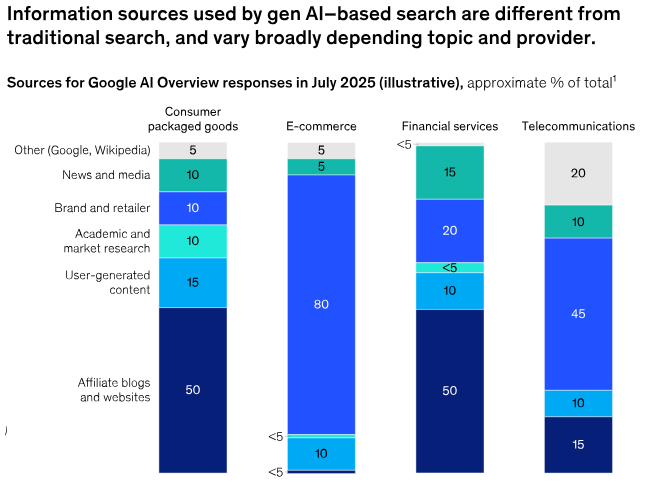
To effectively shape the results that appear in AI-powered searches, brands must first understand two crucial elements the questions consumers are asking and the sources that AI models use to generate their answers. This requires ongoing analysis and constant adaptation as large language models (LLMs) evolve and update their data ecosystems.
At present, very few brands are actively doing this. Even in major sectors such as credit cards, hotels, consumer electronics, and apparel, leading companies are often missing from AI-generated responses on top platforms including Google’s AI Overview.
This means that a brand’s presence in AI search doesn’t necessarily match its market share or visibility in traditional search results. In other words, even high-performing brands risk falling behind in the generative AI landscape simply because they’re not optimizing for the new dynamics of AI-driven discovery and decision-making.
Artificial intelligence has not only reshaped how people think, work, and create it has now built its own gateways to the internet. Platforms once known solely as chatbots have evolved into full-fledged AI search engines: ChatGPT’s Atlas and Perplexity’s Comet are leading this new frontier. These engines don’t just provide answers they interpret intent, analyze massive data ecosystems, and deliver personalized, conversational insights that traditional search could never match.
In this new digital reality, being visible on AI engines has become as vital as ranking on Google once was. Brands that fail to optimize for AI-driven discovery risk vanishing from the conversations that shape purchase decisions. To thrive, companies must strategically position their content, data, and credibility where AI systems source and synthesize information because in the age of intelligent search, visibility isn’t earned by keywords alone, but by relevance, authority, and trust in the eyes of AI.
As AI searches become the new front door to the internet, many brands find themselves racing to keep up. The opportunity is still within reach but it demands a complete rethink of how content is structured, produced, and distributed. Today, only about 16% of brands actively track their search performance, leaving a massive gap for others to close.
To win in this new landscape, companies must act on four key priorities:
AI-powered searches are not a passing trend it’s redefining how consumers find and choose brands. As large language models evolve, they’ll expand their data sources and even integrate paid ad formats, potentially acting as AI agents that make purchase decisions autonomously. The brands that invest in GEO now will not only protect visibility but also secure a decisive advantage in how consumers discover them in the future.
Everything in digital marketing is changing faster than ever. AI-powered search has redefined how consumers discover, evaluate, and choose brands leaving traditional SEO strategies struggling to keep pace. If your business wants to thrive in this evolving landscape, it’s time to move beyond outdated tactics.
Proximate Solutions can help you stay ahead with a complete AI search audit identifying exactly where your brand needs to optimize to gain real visibility and authority in the era of AI-driven discovery. Don’t get lost in the noise of traditional SEO; Book your Free AIO Audit today and discover exactly where your business stands in the new world of AI-powered search. We’ll identify blind spots in your current strategy, highlight untapped growth opportunities, and map out a clear action plan to put you ahead of the competition.
1- What does it mean for a brand to “disappear” in AI search?
In traditional search, you might be on page two. In AI search, if a model like ChatGPT or Gemini doesn’t cite you in its single, conversational answer, you effectively don’t exist for that user’s journey.
2- How is AI search changing consumer behavior?
Users are moving away from browsing lists of links and toward asking complex, specific questions. They expect immediate, synthesized answers rather than doing the research themselves.
3- Can small brands compete with big brands in AI search?
Yes. AI models prioritize accuracy and relevance over massive backlink profiles. A smaller brand with highly specific, authoritative content and clean structured data can often be cited over a larger, more generic competitor.
4- What is the biggest mistake brands make with AI search?
The biggest mistake is sticking to “keyword stuffing” rather than focusing on “Entity SEO” and providing clear, factual data that AI agents can easily verify across multiple platforms.
5- Does social media affect AI search visibility?
Absolutely. AI models often use social media signals and mention to gauge brand authority and “buzz.” Active, consistent brand mentions on social platforms help convince an AI that your brand is a trustworthy recommendation.
6- What is a “Brand Citation” in AI search?
A citation occurs when an AI engine mentions your brand name and provides a link to your site as the source of its information. This is the new “Rank #1” in the age of generative search.
7- How quickly should a brand pivot to an AI-first strategy?
Immediately. AI search engines are currently building their “trust maps” of the internet. Brands that establish themselves as authoritative sources now will have a significant advantage as these models become the primary way people find information.
Half the Internet Has Moved to AI Search. Has Your Marketing Strategy Followed? If not, then you might be missing something huge. Here is the reason why is it so
Still wondering when artificial intelligence will truly transform how people search, research, and discover online? That moment has already arrived. Just as social media once revolutionized how consumers explored and bought products, AI-powered search is now taking center stage. From ChatGPT, Gemini, Copilot, Perplexity, and Claude to Google’s AI Overview, users are increasingly relying on these intelligent engines to guide purchase decisions, compare brands, and uncover new options they might never have found through traditional search.
To illustrate, imagine a shopper researching the best brands for cross-training shoes. Instead of scrolling through endless web pages or review sites, AI-powered search engines now provide personalized insights instantly. These tools can explain which factors matter most—such as price, performance, comfort, and style and highlight which brands excel in specific features. They also identify top-rated models based on real user feedback. Even better, consumers can refine results by adding personal details, like their fitness goals or spending limit, allowing AI systems to deliver tailored recommendations that feel uniquely aligned with their needs.
Recent analyses reveal how deep this transformation runs. Around 50% of Google searches now feature AI-generated summaries, and that share is expected to climb beyond 75% by 2028. According to a McKinsey survey, half of all consumers actively choose AI-driven search platforms, with most considering them their primary digital tool for making buying decisions. Adoption isn’t limited to younger audiences’ older generations, including baby boomers, are also rapidly embracing AI-based discovery. By 2028, an estimated $750 billion in U.S. revenue will flow through AI-powered search channels.
This massive behavioral shift means brands that fail to adapt could see their website traffic drop by 20% to 50% as traditional search volumes decline. Even the remaining clicks from legacy search will evolve most will come from better-informed buyers who have already engaged with AI systems earlier in their decision journey.
To stay competitive, forward-looking companies must focus on visibility and reputation across AI summaries and search platforms. That calls for a complete rethinking of digital content and organic strategy shaping messaging, data, and credibility to appeal not only to humans but also to AI systems that aggregate information. While this transition carries some uncertainty, it also offers a powerful opening. Brands that move swiftly, refine their strategy, and adapt to the AI search era can turn disruption into a decisive competitive advantage.
More than 70% of consumers using AI-driven search engage with it at the top of the funnel seeking to learn about a category, brand, product, or service. Yet, the influence of AI doesn’t stop there. These intelligent search tools are now deeply embedded throughout the entire consumer decision journey, shaping choices from initial discovery to final purchase.
To illustrate, imagine a shopper researching the best brands for cross-training shoes. Instead of scrolling through endless web pages or review sites, AI-powered search engines now provide personalized insights instantly. These tools can explain which factors matter most such as price, performance, comfort, and style and highlight which brands excel in specific features. They also identify top-rated models based on real user feedback. Even better, consumers can refine results by adding personal details, like their fitness goals or spending limit, allowing AI systems to deliver tailored recommendations that feel uniquely aligned with their needs
In the traditional search experience, consumers typically had to navigate through a maze of online content before reaching a decision. They would browse multiple review platforms, explore brand websites, sift through category-specific pages, and scan discussion forums to piece together a clear understanding of their options. It was a time-consuming process that demanded effort and interpretation across scattered sources.
Today, that process is being dramatically simplified. It’s no surprise that between 40% and 55% of consumers across key industries such as consumer electronics, grocery, travel, wellness, apparel, beauty, and financial services now rely on AI-powered search tools to make their purchasing decisions.
The implications of this transformation are unmistakable. Research shows that 44% of AI-powered search users now identify it as their primary and preferred source of information surpassing traditional search engines (31%), retailer or brand websites (9%), and review platforms (6%).
This shift signals a pivotal moment for marketers. For years, search engine optimization (SEO) has served as the cornerstone of digital visibility. But in the emerging landscape, generative AI engine optimization (GEO) must become an essential pillar of every comprehensive marketing and digital strategy. To remain visible and influential across the evolving web, brands must optimize not only for search engines but also for the AI-driven environments where consumers are now making their decisions.
Even the strongest market leaders aren’t guaranteed visibility in the world of AI-driven search. Traditional SEO strategies primarily optimize a brand’s own website content, but that now represents only a small fraction roughly 5 to 10 percent of the total sources referenced by AI-powered search engines.
Instead, these generative models pull information from a wide range of external sources, including affiliate sites, online reviews, forums, and user-generated content. What’s more, the sources an AI model references vary significantly depending on the large language model (LLM) it uses, as well as the user’s location, the product category, and the specific question asked.
As these LLMs continue to evolve, so will the mix of sources they draw from making it increasingly complex for brands to appear where consumer decisions are actually being shaped. For instance, the distribution of data sources used in AI-generated results already differs dramatically across industries and product categories, creating new challenges for consistent visibility and brand representation.
To effectively shape the results that appear in AI-powered searches, brands must first understand two crucial elements the questions consumers are asking and the sources that AI models use to generate their answers. This requires ongoing analysis and constant adaptation as large language models (LLMs) evolve and update their data ecosystems.
At present, very few brands are actively doing this. Even in major sectors such as credit cards, hotels, consumer electronics, and apparel, leading companies are often missing from AI-generated responses on top platforms including Google’s AI Overview.
This means that a brand’s presence in AI search doesn’t necessarily match its market share or visibility in traditional search results. In other words, even high-performing brands risk falling behind in the generative AI landscape simply because they’re not optimizing for the new dynamics of AI-driven discovery and decision-making.
Artificial intelligence has not only reshaped how people think, work, and create it has now built its own gateways to the internet. Platforms once known solely as chatbots have evolved into full-fledged AI search engines: ChatGPT’s Atlas and Perplexity’s Comet are leading this new frontier. These engines don’t just provide answers they interpret intent, analyze massive data ecosystems, and deliver personalized, conversational insights that traditional search could never match.
In this new digital reality, being visible on AI engines has become as vital as ranking on Google once was. Brands that fail to optimize for AI-driven discovery risk vanishing from the conversations that shape purchase decisions. To thrive, companies must strategically position their content, data, and credibility where AI systems source and synthesize information because in the age of intelligent search, visibility isn’t earned by keywords alone, but by relevance, authority, and trust in the eyes of AI.
As AI searches become the new front door to the internet, many brands find themselves racing to keep up. The opportunity is still within reach but it demands a complete rethink of how content is structured, produced, and distributed. Today, only about 16% of brands actively track their search performance, leaving a massive gap for others to close.
To win in this new landscape, companies must act on four key priorities:
AI-powered searches are not a passing trend it’s redefining how consumers find and choose brands. As large language models evolve, they’ll expand their data sources and even integrate paid ad formats, potentially acting as AI agents that make purchase decisions autonomously. The brands that invest in GEO now will not only protect visibility but also secure a decisive advantage in how consumers discover them in the future.
Everything in digital marketing is changing faster than ever. AI-powered search has redefined how consumers discover, evaluate, and choose brands leaving traditional SEO strategies struggling to keep pace. If your business wants to thrive in this evolving landscape, it’s time to move beyond outdated tactics.
Proximate Solutions can help you stay ahead with a complete AI search audit identifying exactly where your brand needs to optimize to gain real visibility and authority in the era of AI-driven discovery. Don’t get lost in the noise of traditional SEO; Book your Free AIO Audit today and discover exactly where your business stands in the new world of AI-powered search. We’ll identify blind spots in your current strategy, highlight untapped growth opportunities, and map out a clear action plan to put you ahead of the competition.
1- What does it mean for a brand to “disappear” in AI search?
In traditional search, you might be on page two. In AI search, if a model like ChatGPT or Gemini doesn’t cite you in its single, conversational answer, you effectively don’t exist for that user’s journey.
2- How is AI search changing consumer behavior?
Users are moving away from browsing lists of links and toward asking complex, specific questions. They expect immediate, synthesized answers rather than doing the research themselves.
3- Can small brands compete with big brands in AI search?
Yes. AI models prioritize accuracy and relevance over massive backlink profiles. A smaller brand with highly specific, authoritative content and clean structured data can often be cited over a larger, more generic competitor.
4- What is the biggest mistake brands make with AI search?
The biggest mistake is sticking to “keyword stuffing” rather than focusing on “Entity SEO” and providing clear, factual data that AI agents can easily verify across multiple platforms.
5- Does social media affect AI search visibility?
Absolutely. AI models often use social media signals and mention to gauge brand authority and “buzz.” Active, consistent brand mentions on social platforms help convince an AI that your brand is a trustworthy recommendation.
6- What is a “Brand Citation” in AI search?
A citation occurs when an AI engine mentions your brand name and provides a link to your site as the source of its information. This is the new “Rank #1” in the age of generative search.
7- How quickly should a brand pivot to an AI-first strategy?
Immediately. AI search engines are currently building their “trust maps” of the internet. Brands that establish themselves as authoritative sources now will have a significant advantage as these models become the primary way people find information.