
Search engine rankings have long been the holy grail of digital success. For years, the mantra was simple: optimize your site for Google using SEO keywords, backlinks, technical structure, and content strategies. But now, there’s a new kid on the block: AIO, or AI Optimization.
With the rise of AI-generated content, smarter algorithms, and voice search, businesses are starting to wonder:
At Proximate Solutions, we’ve seen both sides of the digital evolution. We’ve helped businesses rank #1 with smart SEO and grow their reach faster with AI-powered tools. In this blog, we’ll break down the difference between AIO and Traditional SEO and help you decide which path is right for your business in 2025 and beyond.
AIO stands for AI Optimization, a new approach to content and digital strategy that leverages artificial intelligence tools like ChatGPT, Jasper, Gemini, Surfer SEO, and others to create, refine, and optimize content.
But it’s not just about generating text. AIO includes:
Think of it as SEO 2.0 is faster, smarter, and more responsive to how modern users (and algorithms) behave.
Make your site the obvious answer in Google and AI tools like Perplexity and ChatGPT.
Proximate Solutions will audit your site and deliver a simple plan you can act on immediately.
What you get (no cost, no commitment):Claim Your Custom AI Visibility & Growth Blueprint
Yes, I Want My Free Blueprint →

Traditional SEO refers to the classic method of optimizing websites to rank higher in search engines. It focuses on:
It’s human-powered, time-tested, and rooted in Google’s search principles.
Let’s break down the biggest differences between the two approaches:
| Aspect | Traditional SEO | AIO (AI Optimization) |
| Content Creation | Human-written, often slower | AI-assisted or AI-generated, faster |
| Keyword Strategy | Manual research via tools like SEMrush | AI-suggested and dynamically adapted |
| Speed | Time-consuming processes | Rapid deployment of optimized content |
| Voice & Conversational SEO | Limited integration | Built with voice/search AI in mind |
| Scalability | Difficult to scale quickly | Easily scalable with AI systems |
| Personalization | Generic or segmented | Hyper-personalized via AI learning |
| Cost Efficiency | Higher cost (writers, SEOs) | Lower content production costs |
Despite the AI wave, traditional SEO still has its strengths:
Experienced SEO professionals understand nuance, brand tone, and emotional appeal something AI still struggles to replicate authentically.
Google emphasizes Expertise, Authoritativeness, and Trustworthiness (E-A-T). Human-authored content often performs better in highly regulated or sensitive niches (like health or finance).
Quality backlinks require outreach, relationship building, and credibility tasks better handled by humans.
When done right, traditional SEO can lead to long-term, compounding returns that don’t require constant AI tweaking.
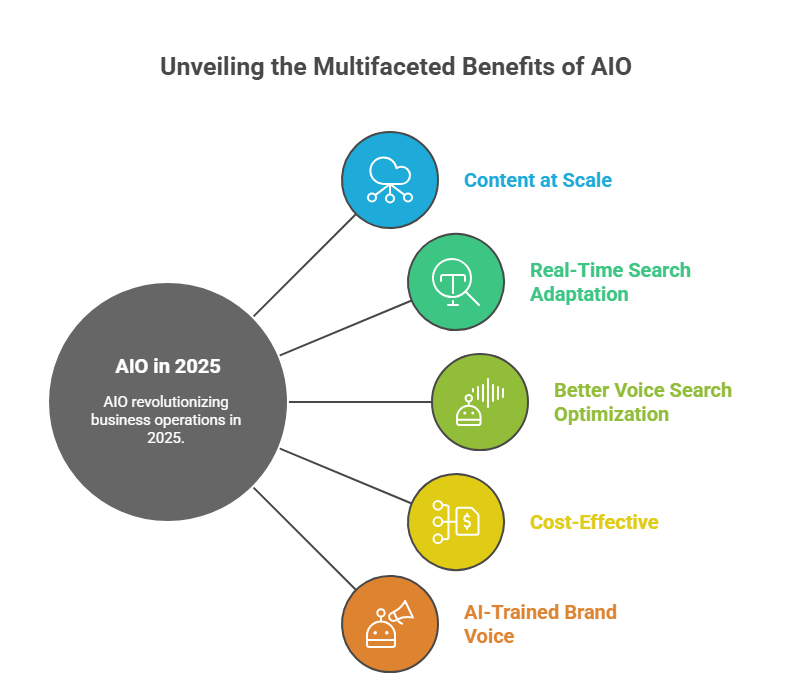
Here’s why many businesses are embracing AIO in the new digital landscape:
Need 50 blog posts in a month? AIO makes it possible without burning out your marketing team. AI tools can generate high-quality drafts that are refined with human editing.
AI tools now integrate with live data sources, allowing you to adapt to trending searches faster than traditional SEO ever could.
With over 50% of searches happening via voice assistants in 2025, AIO helps optimize content in a natural, conversational tone key for ranking in featured snippets and AI-driven results.
Instead of hiring large content teams, businesses can produce content more affordably by pairing AI writers with human editors.
Advanced AIO strategies allow businesses to “train” their AI models to reflect brand tone and style offering both speed and consistency.
The smartest businesses in 2025 don’t view AIO and SEO as opposing forces they use them together.
At Proximate Solutions, we recommend a hybrid approach:
This combo allows businesses to scale without sacrificing quality.
Let’s say you run an eCommerce skincare brand.
Traditional SEO strategy:
AIO-enhanced strategy:
You publish faster, rank quicker, and free your team for higher-level creative work.
Contrary to popular belief, Google does not penalize AI-generated content as long as it’s helpful, original, and high quality.
According to their latest guidance:
“What matters most is content quality, regardless of how it’s produced. Automatically generated content is fine when it meets our helpful content criteria.”
So the focus is still on value, not the method. AIO content that genuinely helps users can (and does) rank well.
Let’s break it down based on business goals:
| Your Business Goal | Go With |
| You want to scale content fast | AIO |
| You’re in a regulated industry (finance, legal, health) | Traditional SEO |
| You need to win voice or AI search | AIO |
| You rely heavily on backlinks | Traditional SEO |
| You’re a startup with a small team | AIO + light human editing |
| You want long-term brand equity and trust | Traditional SEO + AIO blend |
At Proximate Solutions, we help businesses build smart, scalable SEO strategies tailored to today’s algorithms and tomorrow’s demands.
CEO Adeel Arshad sums it up perfectly:
“The future of SEO isn’t human vs. AI but it’s human with AI. The winners will be businesses who adapt faster without compromising authenticity.”
We offer:
Whether you’re new to SEO or ready to level up your AI game, we’ll help you dominate the SERPs the smart way.
AIO is here, and it’s powerful. But traditional SEO isn’t going anywhere it’s just evolving.
Your job as a business owner or marketer isn’t to pick a side. It’s to build a funnel strategy that integrates the best of both worlds: AI speed with human touch.
Done right, your content won’t just rank it’ll resonate, convert, and compound over time.
1- What exactly is AI Optimization (AIO)?
AIO refers to the strategic process of configuring your digital presence to be easily indexed and cited by AI-driven search models and Large Language Models (LLMs) such as Gemini, ChatGPT, and Claude. While traditional SEO optimizes for position within a indexed list of hyperlinks, AIO focuses on positioning your brand as the synthesized answer generated by the AI.
2- Does traditional SEO remain relevant in 2026?
Yes. Traditional SEO provides the technical infrastructure such as page velocity, responsive mobile design, and logical indexing architectures that AI models rely upon to crawl and cross-verify site data. AIO represents a strategic evolution of search marketing rather than a complete replacement of core SEO methodologies.
3- How does AIO impact an organization’s content strategy?
AIO demands the production of “citation-ready” digital assets. Instead of merely scattering keyword clusters throughout your text, content must feature clear, authoritative, factual data layers and robust schema markups that algorithmic models can seamlessly parse, summarize, and attribute to your brand.
4- Which methodology should a business prioritize: AIO or SEO?
The prioritization depends entirely on target consumer behaviors. If your audience relies heavily on conversational search platforms or voice interfaces, accelerating your AIO framework is critical. Conversely, for high-intent transactional search queries, traditional SEO remains indispensable for maintaining steady organic acquisition channels.
5- What is the fundamental difference between AIO and SEO ranking variables?
Traditional SEO heavily weighs backlink profiles and keyword density metrics. In contrast, AIO prioritizes deep contextual relevance, structured semantic data (Schema), and the algorithm’s capability to cross-validate your information across a network of independent, high-authority web ecosystems.
6- Can a local business leverage AIO strategies effectively?
Absolutely. AI search mechanisms frequently handle geo-targeted “near me” inquiries by synthesizing localized business datasets. Implementing AIO methodologies ensures your commercial details are sufficiently uniform, accurate, and authoritative to be recommended over local competitors.
7- By what metrics do organizations evaluate the performance of an AIO campaign?
Unlike traditional SEO, which evaluates keyword rankings across standard search engine results pages, AIO success is benchmarked via “Share of Model” metrics measuring how frequently an LLM cites your website as its definitive source. Analytics platforms are continuously updating to help digital marketers track these specific AI impressions.
Search engine rankings have long been the holy grail of digital success. For years, the mantra was simple: optimize your site for Google using SEO keywords, backlinks, technical structure, and content strategies. But now, there’s a new kid on the block: AIO, or AI Optimization.
With the rise of AI-generated content, smarter algorithms, and voice search, businesses are starting to wonder:
At Proximate Solutions, we’ve seen both sides of the digital evolution. We’ve helped businesses rank #1 with smart SEO and grow their reach faster with AI-powered tools. In this blog, we’ll break down the difference between AIO and Traditional SEO and help you decide which path is right for your business in 2025 and beyond.
AIO stands for AI Optimization, a new approach to content and digital strategy that leverages artificial intelligence tools like ChatGPT, Jasper, Gemini, Surfer SEO, and others to create, refine, and optimize content.
But it’s not just about generating text. AIO includes:
Think of it as SEO 2.0 is faster, smarter, and more responsive to how modern users (and algorithms) behave.
Make your site the obvious answer in Google and AI tools like Perplexity and ChatGPT.
Proximate Solutions will audit your site and deliver a simple plan you can act on immediately.
What you get (no cost, no commitment):Claim Your Custom AI Visibility & Growth Blueprint
Yes, I Want My Free Blueprint →
Traditional SEO refers to the classic method of optimizing websites to rank higher in search engines. It focuses on:
It’s human-powered, time-tested, and rooted in Google’s search principles.
Let’s break down the biggest differences between the two approaches:
| Aspect | Traditional SEO | AIO (AI Optimization) |
| Content Creation | Human-written, often slower | AI-assisted or AI-generated, faster |
| Keyword Strategy | Manual research via tools like SEMrush | AI-suggested and dynamically adapted |
| Speed | Time-consuming processes | Rapid deployment of optimized content |
| Voice & Conversational SEO | Limited integration | Built with voice/search AI in mind |
| Scalability | Difficult to scale quickly | Easily scalable with AI systems |
| Personalization | Generic or segmented | Hyper-personalized via AI learning |
| Cost Efficiency | Higher cost (writers, SEOs) | Lower content production costs |
Despite the AI wave, traditional SEO still has its strengths:
Experienced SEO professionals understand nuance, brand tone, and emotional appeal something AI still struggles to replicate authentically.
Google emphasizes Expertise, Authoritativeness, and Trustworthiness (E-A-T). Human-authored content often performs better in highly regulated or sensitive niches (like health or finance).
Quality backlinks require outreach, relationship building, and credibility tasks better handled by humans.
When done right, traditional SEO can lead to long-term, compounding returns that don’t require constant AI tweaking.
Here’s why many businesses are embracing AIO in the new digital landscape:
Need 50 blog posts in a month? AIO makes it possible without burning out your marketing team. AI tools can generate high-quality drafts that are refined with human editing.
AI tools now integrate with live data sources, allowing you to adapt to trending searches faster than traditional SEO ever could.
With over 50% of searches happening via voice assistants in 2025, AIO helps optimize content in a natural, conversational tone key for ranking in featured snippets and AI-driven results.
Instead of hiring large content teams, businesses can produce content more affordably by pairing AI writers with human editors.
Advanced AIO strategies allow businesses to “train” their AI models to reflect brand tone and style offering both speed and consistency.
The smartest businesses in 2025 don’t view AIO and SEO as opposing forces they use them together.
At Proximate Solutions, we recommend a hybrid approach:
This combo allows businesses to scale without sacrificing quality.
Let’s say you run an eCommerce skincare brand.
Traditional SEO strategy:
AIO-enhanced strategy:
You publish faster, rank quicker, and free your team for higher-level creative work.
Contrary to popular belief, Google does not penalize AI-generated content as long as it’s helpful, original, and high quality.
According to their latest guidance:
“What matters most is content quality, regardless of how it’s produced. Automatically generated content is fine when it meets our helpful content criteria.”
So the focus is still on value, not the method. AIO content that genuinely helps users can (and does) rank well.
Let’s break it down based on business goals:
| Your Business Goal | Go With |
| You want to scale content fast | AIO |
| You’re in a regulated industry (finance, legal, health) | Traditional SEO |
| You need to win voice or AI search | AIO |
| You rely heavily on backlinks | Traditional SEO |
| You’re a startup with a small team | AIO + light human editing |
| You want long-term brand equity and trust | Traditional SEO + AIO blend |
At Proximate Solutions, we help businesses build smart, scalable SEO strategies tailored to today’s algorithms and tomorrow’s demands.
CEO Adeel Arshad sums it up perfectly:
“The future of SEO isn’t human vs. AI but it’s human with AI. The winners will be businesses who adapt faster without compromising authenticity.”
We offer:
Whether you’re new to SEO or ready to level up your AI game, we’ll help you dominate the SERPs the smart way.
AIO is here, and it’s powerful. But traditional SEO isn’t going anywhere it’s just evolving.
Your job as a business owner or marketer isn’t to pick a side. It’s to build a funnel strategy that integrates the best of both worlds: AI speed with human touch.
Done right, your content won’t just rank it’ll resonate, convert, and compound over time.
1- What exactly is AI Optimization (AIO)?
AIO refers to the strategic process of configuring your digital presence to be easily indexed and cited by AI-driven search models and Large Language Models (LLMs) such as Gemini, ChatGPT, and Claude. While traditional SEO optimizes for position within a indexed list of hyperlinks, AIO focuses on positioning your brand as the synthesized answer generated by the AI.
2- Does traditional SEO remain relevant in 2026?
Yes. Traditional SEO provides the technical infrastructure such as page velocity, responsive mobile design, and logical indexing architectures that AI models rely upon to crawl and cross-verify site data. AIO represents a strategic evolution of search marketing rather than a complete replacement of core SEO methodologies.
3- How does AIO impact an organization’s content strategy?
AIO demands the production of “citation-ready” digital assets. Instead of merely scattering keyword clusters throughout your text, content must feature clear, authoritative, factual data layers and robust schema markups that algorithmic models can seamlessly parse, summarize, and attribute to your brand.
4- Which methodology should a business prioritize: AIO or SEO?
The prioritization depends entirely on target consumer behaviors. If your audience relies heavily on conversational search platforms or voice interfaces, accelerating your AIO framework is critical. Conversely, for high-intent transactional search queries, traditional SEO remains indispensable for maintaining steady organic acquisition channels.
5- What is the fundamental difference between AIO and SEO ranking variables?
Traditional SEO heavily weighs backlink profiles and keyword density metrics. In contrast, AIO prioritizes deep contextual relevance, structured semantic data (Schema), and the algorithm’s capability to cross-validate your information across a network of independent, high-authority web ecosystems.
6- Can a local business leverage AIO strategies effectively?
Absolutely. AI search mechanisms frequently handle geo-targeted “near me” inquiries by synthesizing localized business datasets. Implementing AIO methodologies ensures your commercial details are sufficiently uniform, accurate, and authoritative to be recommended over local competitors.
7- By what metrics do organizations evaluate the performance of an AIO campaign?
Unlike traditional SEO, which evaluates keyword rankings across standard search engine results pages, AIO success is benchmarked via “Share of Model” metrics measuring how frequently an LLM cites your website as its definitive source. Analytics platforms are continuously updating to help digital marketers track these specific AI impressions.