A new wave of AI-driven search engines like ChatGPT Search, Google’s Gemini, and Perplexity is changing the way users discover online stores. For Shopify merchants, this shift means your products must be not only visible on Google but also structured and optimized for AI assistants that now feed recommendations directly. Successfully landing in those responses can dramatically boost traffic, trust, and sales.
Here’s how Shopify store owners can prepare and rank in this new AI-powered era of search.
In late 2024, OpenAI released ChatGPT Search (formerly “SearchGPT”), transforming ChatGPT into a search engine counterpart that directly answers queries using AI-generated summaries and citations.
Meanwhile, Perplexity AI is pushing into retail by adding visual product cards and “Snap to Shop” features tied to Shopify-like platforms, making product discovery more visual and conversational.
These platforms favor clear, structured answers, like “What’s the best eco-friendly yoga mat under $50?” not just keyword-stuffed pages.
Make your site the obvious answer in Google and AI tools like Perplexity and ChatGPT.
Proximate Solutions will audit your site and deliver a simple plan you can act on immediately.
What you get (no cost, no commitment):Claim Your Custom AI Visibility & Growth Blueprint
Yes, I Want My Free Blueprint →

As traditional SEO shifts to GEO (Generative Engine Optimization) and AEO (Answer Engine Optimization), your Shopify site must adapt or risk getting overshadowed. AI platforms prioritize:
In short: AI search engines serve answers, not links, so your Shopify store needs to provide clear, reliable responses to user queries.
AI bots thrive on answering direct, query-based questions. Add FAQ sections to help shoppers ask:
Use FAQ schema so ChatGPT & Gemini can extract your responses clearly.
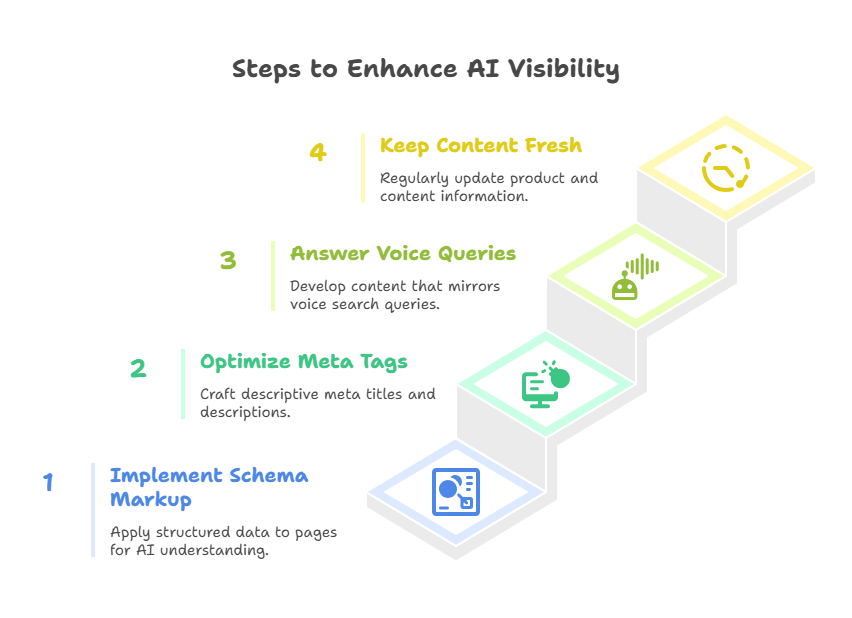
Apply Product, FAQ, Review, or How-To schema to your Shopify pages. Correct structured data ensures AI platforms properly understand your inventory details, pricing, shipping, and reviews, which enables rich snippets and direct answers in AI search results. This markup provides AI engines with the precise context needed to feature your online store in answer boxes, carousels, or comparison buying guides.
You can automate this process by using Shopify apps such as “JSON-LD for SEO” or “Smart SEO.” The more detailed your structured data is, the higher your chances of being surfaced in conversational search results on platforms like ChatGPT, Gemini, and Perplexity. Implementing schema is one of the easiest and most effective ways to boost your AI visibility.
AI engines still use metadata for context. Ensure titles and descriptions are descriptive and match queries people would ask in natural language. This improves click-through rates and makes your pages more AI-friendly.
Avoid stuffing keywords focus on clarity and user intent. For example, instead of “Luxury Candles – Home Fragrance Store,” try “Shop Luxury Soy Candles for Relaxing Home Scents | Free Shipping.” Think of your meta tags as mini answers to questions a customer would ask. Tools like Ahrefs and SurferSEO can help optimize them for semantic relevance and real-world queries AI tools often reflect.
Develop content that mirrors voice search: “Where can I buy sustainable yoga mats in New York?” or “Best gifts for new homeowners under $100.” Keep your tone conversational and content concise. Voice search queries are typically longer and more question-based, which matches how users talk to AI chatbots. Integrate those questions directly into your blogs, product FAQs, and collection page copy. Use natural phrasing, contractions, and direct answers within the first few sentences. This helps AI tools extract your content easily and boosts your chances of being referenced in voice-based AI interactions on phones, smart speakers, and assistants.
AI-driven search engines prioritize up-to-date information. Regularly update product specs, pricing, availability, and restock FAQs. AI tools penalize outdated or inaccurate info.
Freshness signals that your store is active, trustworthy, and responsive to changes qualities AI platforms look for when surfacing recommendations. Set a routine to revisit your top-performing pages monthly. Add new blog posts related to seasons, trends, or launches. Updating older blogs with new info also boosts relevance. Shopify’s “back in stock” alerts, real-time inventory updates, and consistent content publishing all help you stay competitive in AI results.
Platforms like ChatGPT often favor recognized, trusted brands with established digital presence. To increase visibility:
Shopify store owners should go beyond product listings:
These techniques help large language models build knowledge graphs of your site a critical factor in AI rankings.
AI search engines pull from diverse formats. Complement written content with:
Engagement is a ranking signal even for AI. Longer dwell time, clickable content, and interactive elements help.
The way users discover products is evolving AI engines like ChatGPT Search, Gemini, and Perplexity provide direct answers instead of just listing links. Shopify store owners who adapt their content, structure, and metadata will appear in those AI-powered responses and capture high-intent traffic.
Whether through well-structured product pages, conversational blog content, or FAQ markup, ranking in AI search engines is now both achievable and essential.
At Proximate Solutions, we specialize in gearing Shopify brands for this rising wave helping you adopt AEO/GEO best practices, semantic SEO, and structured content that AI can reference confidently.
Want to make your store AI-searchable? Get in touch we’ll help you be the brand that AI recommends next.
1- What is GEO and why is it critical for Shopify stores?
Generative Engine Optimization (GEO) is the practice of structuring your website’s data so conversational AI models can easily parse, verify, and cite your brand. With a rapidly growing segment of consumers using AI search assistants to discover products, lacking a dedicated GEO framework means your inventory will remain invisible to conversational recommendation engines, resulting in lost market share.
2- How do I position my Shopify products to be recommended by ChatGPT Search?
Securing recommendations in ChatGPT Search requires establishing deep entity clarity. You must deploy advanced JSON-LD structured data (including Product, ProductGroup, AggregateRating, and FAQ schemas) so the model can instantly validate real-time pricing, stock status, and brand trust. Furthermore, earning authoritative backlinks and mentions on reputable third-party publications provides the external citations that AI models require to trust and recommend your products.
3- Does traditional Shopify SEO still yield results?
Yes, but the playbook has fundamentally shifted. While standard search factors remain foundational, AI search engines prioritize deep topical authority and comprehensive intent matching over simple keyword placement. Succeeding today requires building robust semantic content clusters—highly structured, interlinked networks of authoritative articles and guides that algorithmically prove your brand’s subject matter expertise in your niche.
4- What are “llms.txt” files and should I implement one on Shopify?
An llms.txt file is a modern markdown-based file hosted at your root directory that serves as a clean, machine-readable directory optimized specifically for AI crawlers. Deploying this file helps LLM-based crawlers (such as Claude and Perplexity) rapidly ingest your product catalogs and technical data, drastically reducing the risk of the model hallucinating incorrect product specs, pricing, or inventory details in conversational search results.
A new wave of AI-driven search engines like ChatGPT Search, Google’s Gemini, and Perplexity is changing the way users discover online stores. For Shopify merchants, this shift means your products must be not only visible on Google but also structured and optimized for AI assistants that now feed recommendations directly. Successfully landing in those responses can dramatically boost traffic, trust, and sales.
Here’s how Shopify store owners can prepare and rank in this new AI-powered era of search.
In late 2024, OpenAI released ChatGPT Search (formerly “SearchGPT”), transforming ChatGPT into a search engine counterpart that directly answers queries using AI-generated summaries and citations.
Meanwhile, Perplexity AI is pushing into retail by adding visual product cards and “Snap to Shop” features tied to Shopify-like platforms, making product discovery more visual and conversational.
These platforms favor clear, structured answers, like “What’s the best eco-friendly yoga mat under $50?” not just keyword-stuffed pages.
Make your site the obvious answer in Google and AI tools like Perplexity and ChatGPT.
Proximate Solutions will audit your site and deliver a simple plan you can act on immediately.
What you get (no cost, no commitment):Claim Your Custom AI Visibility & Growth Blueprint
Yes, I Want My Free Blueprint →
As traditional SEO shifts to GEO (Generative Engine Optimization) and AEO (Answer Engine Optimization), your Shopify site must adapt or risk getting overshadowed. AI platforms prioritize:
In short: AI search engines serve answers, not links, so your Shopify store needs to provide clear, reliable responses to user queries.
AI bots thrive on answering direct, query-based questions. Add FAQ sections to help shoppers ask:
Use FAQ schema so ChatGPT & Gemini can extract your responses clearly.
Apply Product, FAQ, Review, or How-To schema to your Shopify pages. Correct structured data ensures AI platforms properly understand your inventory details, pricing, shipping, and reviews, which enables rich snippets and direct answers in AI search results. This markup provides AI engines with the precise context needed to feature your online store in answer boxes, carousels, or comparison buying guides.
You can automate this process by using Shopify apps such as “JSON-LD for SEO” or “Smart SEO.” The more detailed your structured data is, the higher your chances of being surfaced in conversational search results on platforms like ChatGPT, Gemini, and Perplexity. Implementing schema is one of the easiest and most effective ways to boost your AI visibility.
AI engines still use metadata for context. Ensure titles and descriptions are descriptive and match queries people would ask in natural language. This improves click-through rates and makes your pages more AI-friendly.
Avoid stuffing keywords focus on clarity and user intent. For example, instead of “Luxury Candles – Home Fragrance Store,” try “Shop Luxury Soy Candles for Relaxing Home Scents | Free Shipping.” Think of your meta tags as mini answers to questions a customer would ask. Tools like Ahrefs and SurferSEO can help optimize them for semantic relevance and real-world queries AI tools often reflect.
Develop content that mirrors voice search: “Where can I buy sustainable yoga mats in New York?” or “Best gifts for new homeowners under $100.” Keep your tone conversational and content concise. Voice search queries are typically longer and more question-based, which matches how users talk to AI chatbots. Integrate those questions directly into your blogs, product FAQs, and collection page copy. Use natural phrasing, contractions, and direct answers within the first few sentences. This helps AI tools extract your content easily and boosts your chances of being referenced in voice-based AI interactions on phones, smart speakers, and assistants.
AI-driven search engines prioritize up-to-date information. Regularly update product specs, pricing, availability, and restock FAQs. AI tools penalize outdated or inaccurate info.
Freshness signals that your store is active, trustworthy, and responsive to changes qualities AI platforms look for when surfacing recommendations. Set a routine to revisit your top-performing pages monthly. Add new blog posts related to seasons, trends, or launches. Updating older blogs with new info also boosts relevance. Shopify’s “back in stock” alerts, real-time inventory updates, and consistent content publishing all help you stay competitive in AI results.
Platforms like ChatGPT often favor recognized, trusted brands with established digital presence. To increase visibility:
Shopify store owners should go beyond product listings:
These techniques help large language models build knowledge graphs of your site a critical factor in AI rankings.
AI search engines pull from diverse formats. Complement written content with:
Engagement is a ranking signal even for AI. Longer dwell time, clickable content, and interactive elements help.
The way users discover products is evolving AI engines like ChatGPT Search, Gemini, and Perplexity provide direct answers instead of just listing links. Shopify store owners who adapt their content, structure, and metadata will appear in those AI-powered responses and capture high-intent traffic.
Whether through well-structured product pages, conversational blog content, or FAQ markup, ranking in AI search engines is now both achievable and essential.
At Proximate Solutions, we specialize in gearing Shopify brands for this rising wave helping you adopt AEO/GEO best practices, semantic SEO, and structured content that AI can reference confidently.
Want to make your store AI-searchable? Get in touch we’ll help you be the brand that AI recommends next.
1- What is GEO and why is it critical for Shopify stores?
Generative Engine Optimization (GEO) is the practice of structuring your website’s data so conversational AI models can easily parse, verify, and cite your brand. With a rapidly growing segment of consumers using AI search assistants to discover products, lacking a dedicated GEO framework means your inventory will remain invisible to conversational recommendation engines, resulting in lost market share.
2- How do I position my Shopify products to be recommended by ChatGPT Search?
Securing recommendations in ChatGPT Search requires establishing deep entity clarity. You must deploy advanced JSON-LD structured data (including Product, ProductGroup, AggregateRating, and FAQ schemas) so the model can instantly validate real-time pricing, stock status, and brand trust. Furthermore, earning authoritative backlinks and mentions on reputable third-party publications provides the external citations that AI models require to trust and recommend your products.
3- Does traditional Shopify SEO still yield results?
Yes, but the playbook has fundamentally shifted. While standard search factors remain foundational, AI search engines prioritize deep topical authority and comprehensive intent matching over simple keyword placement. Succeeding today requires building robust semantic content clusters—highly structured, interlinked networks of authoritative articles and guides that algorithmically prove your brand’s subject matter expertise in your niche.
4- What are “llms.txt” files and should I implement one on Shopify?
An llms.txt file is a modern markdown-based file hosted at your root directory that serves as a clean, machine-readable directory optimized specifically for AI crawlers. Deploying this file helps LLM-based crawlers (such as Claude and Perplexity) rapidly ingest your product catalogs and technical data, drastically reducing the risk of the model hallucinating incorrect product specs, pricing, or inventory details in conversational search results.