
Internet information searches proceed through rapid changes in human behavior. The digital landscape has changed because of rising popularity among virtual assistant users, including the tools Google Assistant, Amazon Alexa, Apple’s Siri, and Microsoft Cortana. Users depend on voice commands to obtain quick solutions through search methods rather than search engine typing interfaces.
Organizations and their marketing teams need to adopt voice search optimization (VSO) techniques because they help maintain market competitiveness within the growing voice-enabled digital environment. Businesses should integrate voice search optimization by enhancing their content and website structure, as well as their search engine optimization approach to interpret human speech patterns and conversational search terms.
Future predictions show that voice-based queries represent more than 50% of total searches; thus, organizations that neglect voice search optimization lose visibility, traffic, and customer potential. At Proximate Solutions, we have outlined every necessary detail regarding voice search optimization that you need to know.
With the rapid changes in technology and human behavior, voice searches are just becoming more than usual and continue to become the future of online queries. Here is how the voice search becomes the future of online queries:
Voice search has gained rapid popularity because the use of smart speakers and mobile devices for voice activation has become more prevalent. Users now use Amazon Echo, Google Nest, and Apple HomePod to conduct hands-free searches conveniently.
Make your site the obvious answer in Google and AI tools like Perplexity and ChatGPT.
Proximate Solutions will audit your site and deliver a simple plan you can act on immediately.
What you get (no cost, no commitment):Claim Your Custom AI Visibility & Growth Blueprint
Yes, I Want My Free Blueprint →

Because voice assistants now appear on mobile phones while smart speakers dominate, every home user now uses voice commands for basic questions, online shopping, and smart home device operation.
The process of typing consumes more time than verbally voicing your query. Users can receive immediate hands-free results through voice search, making it ideally suited for mobile users, drivers, and those who do multiple tasks simultaneously. Research indicates that the efficiency of voice searches makes them the standard method of online searching in the future.
People utilize voice searches differently from text searches by creating whole questions that are longer and have a conversational style. A voice user prefers to find “what is the best coffee shop near me” instead of searching for “best coffee shop in London.”
Internet search tools equipped with AI Natural Language Processing understand speech patterns, intent, and contextual information. Businesses require adapting their content for extensive natural language inquiries beyond standard keyword matching systems.
As voice searches are becoming more popular than ever before, businesses need to optimize voice searches to tackle customers’ queries instantly.
Traditional SEO typically works around short-tail keywords like “best coffee shop.” However, when it comes to voice search, users usually put their query in a conversational manner that leads in rise to long-tail keywords and question-based searches. Examples of this include “What is the best coffee shop near me.” You can optimize voice search with this strategy easily.
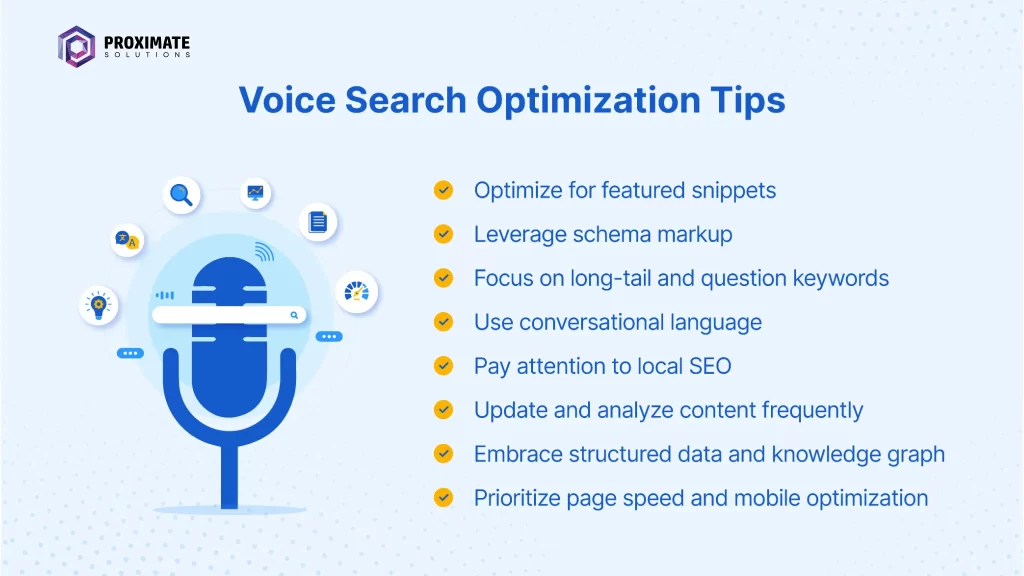
Voice searches occur on mobile devices. This is exactly what makes it extremely crucial to ensure that websites are fast, responsive, and mobile-friendly. You can easily optimize voice searches by improving page load speed and mobile optimization by following simple steps:
There is a strong connection between voice search optimization and local search queries. Research shows that there are 46% of all Google searches have local intent. With voice search, users are even more likely to search for businesses, services, and products near their location. People typically look for immediate location-based solutions like “find a coffee shop open now in New York”. It is very easy to optimize for Local Search & “Near Me” Queries.
The voice search results that Google presents usually derive from featured snippets, which occupy the top spot of search result pages and are known as Position Zero. If you want to optimize, it calls for simple and easy steps.
Structured data simplifies content classification for search engines, which enhances the likelihood of voice search results inclusion. For better understanding, you can easily implement schema markup.
The delivery of voice search results gives preference to content originating from valid, authoritative, trustworthy expert sources. If you are just wondering how to optimize so, it is very easy.
Voice search functions beyond being a trending phenomenon because it transforms consumer search interactions with both search platforms and commercial operations. With the rise of voice assistants, mobile-first browsing, and AI-driven search queries, Business success depends on voice search optimization. Combining conversational keywords with mobile optimization, structured data, and local SEO strategies helps businesses succeed in voice-driven digital environments. Companies that adapt their search strategies to the voice-first trend will determine the future search results.
Your business requires an improved digital footprint, and nothing works better than voice search optimization in this evolving world to remain competitive. Professionals at Proximate Solutions are ready to provide specialized SEO and digital marketing solutions through their website.
Here is the polished, rewritten version of your voice search optimization FAQs. The core operational and technical concepts—including conversational intent, long-tail query structures, featured snippet targets, position zero optimization, and mobile dependencies—remain completely intact. The language has been elevated to match an authoritative, enterprise-grade SEO publication.
1- What does voice search optimization entail?
Voice search optimization refers to the strategic refinement of web content to achieve visibility for spoken queries executed via mobile devices, smart speakers, and conversational AI assistants.
2- Why is adapting to voice queries critical for modern SEO?
With conversational search adoption expanding rapidly, optimizing for voice enables brands to secure emerging organic traffic flows and maintain prominence as search paradigms shift toward natural language processing.
3- In what ways do voice queries diverge from traditional text-based searches?
Voice inputs are distinctly more conversational, verbose, and frequently phrased as complete interrogative sentences, contrasting sharply with the concise, fragmented keyword strings typical of desktop or mobile text inputs.
4- What are the primary techniques for configuring a website for voice search?
Effective optimization requires focusing on natural language patterns, integrating long-tail conversational variants, embedding structured FAQ modules, maximizing page loading performance, and ensuring a flawless mobile user experience.
5- Which keyword frameworks yield the best performance in voice optimization?
Descriptive long-tail phrases and natural question-based structures incorporating introductory markers such as “how,” “what,” and “where” deliver the highest alignment with spoken search patterns.
6- Does voice search integration influence traditional organic search rankings?
Yes. Implementing voice-centric strategies directly enhances a website’s capacity to secure featured snippets, conversational data blocks, and coveted position zero placements on search engine result pages.
7- What correlation exists between mobile device optimization and voice search?
The relationship is absolute; because a vast majority of verbal queries originate from smartphones, maintaining a highly responsive, fast-loading, and mobile-first technical architecture is non-negotiable for voice visibility.
8- Is voice query management becoming a permanent fixture in SEO strategy?
Unquestionably. Spoken query adjustment has evolved into a foundational component of modern search optimization, driven by the escalating consumer reliance on digital voice assistants for instantaneous information retrieval.
Internet information searches proceed through rapid changes in human behavior. The digital landscape has changed because of rising popularity among virtual assistant users, including the tools Google Assistant, Amazon Alexa, Apple’s Siri, and Microsoft Cortana. Users depend on voice commands to obtain quick solutions through search methods rather than search engine typing interfaces.
Organizations and their marketing teams need to adopt voice search optimization (VSO) techniques because they help maintain market competitiveness within the growing voice-enabled digital environment. Businesses should integrate voice search optimization by enhancing their content and website structure, as well as their search engine optimization approach to interpret human speech patterns and conversational search terms.
Future predictions show that voice-based queries represent more than 50% of total searches; thus, organizations that neglect voice search optimization lose visibility, traffic, and customer potential. At Proximate Solutions, we have outlined every necessary detail regarding voice search optimization that you need to know.
With the rapid changes in technology and human behavior, voice searches are just becoming more than usual and continue to become the future of online queries. Here is how the voice search becomes the future of online queries:
Voice search has gained rapid popularity because the use of smart speakers and mobile devices for voice activation has become more prevalent. Users now use Amazon Echo, Google Nest, and Apple HomePod to conduct hands-free searches conveniently.
Make your site the obvious answer in Google and AI tools like Perplexity and ChatGPT.
Proximate Solutions will audit your site and deliver a simple plan you can act on immediately.
What you get (no cost, no commitment):Claim Your Custom AI Visibility & Growth Blueprint
Yes, I Want My Free Blueprint →
Because voice assistants now appear on mobile phones while smart speakers dominate, every home user now uses voice commands for basic questions, online shopping, and smart home device operation.
The process of typing consumes more time than verbally voicing your query. Users can receive immediate hands-free results through voice search, making it ideally suited for mobile users, drivers, and those who do multiple tasks simultaneously. Research indicates that the efficiency of voice searches makes them the standard method of online searching in the future.
People utilize voice searches differently from text searches by creating whole questions that are longer and have a conversational style. A voice user prefers to find “what is the best coffee shop near me” instead of searching for “best coffee shop in London.”
Internet search tools equipped with AI Natural Language Processing understand speech patterns, intent, and contextual information. Businesses require adapting their content for extensive natural language inquiries beyond standard keyword matching systems.
As voice searches are becoming more popular than ever before, businesses need to optimize voice searches to tackle customers’ queries instantly.
Traditional SEO typically works around short-tail keywords like “best coffee shop.” However, when it comes to voice search, users usually put their query in a conversational manner that leads in rise to long-tail keywords and question-based searches. Examples of this include “What is the best coffee shop near me.” You can optimize voice search with this strategy easily.
Voice searches occur on mobile devices. This is exactly what makes it extremely crucial to ensure that websites are fast, responsive, and mobile-friendly. You can easily optimize voice searches by improving page load speed and mobile optimization by following simple steps:
There is a strong connection between voice search optimization and local search queries. Research shows that there are 46% of all Google searches have local intent. With voice search, users are even more likely to search for businesses, services, and products near their location. People typically look for immediate location-based solutions like “find a coffee shop open now in New York”. It is very easy to optimize for Local Search & “Near Me” Queries.
The voice search results that Google presents usually derive from featured snippets, which occupy the top spot of search result pages and are known as Position Zero. If you want to optimize, it calls for simple and easy steps.
Structured data simplifies content classification for search engines, which enhances the likelihood of voice search results inclusion. For better understanding, you can easily implement schema markup.
The delivery of voice search results gives preference to content originating from valid, authoritative, trustworthy expert sources. If you are just wondering how to optimize so, it is very easy.
Voice search functions beyond being a trending phenomenon because it transforms consumer search interactions with both search platforms and commercial operations. With the rise of voice assistants, mobile-first browsing, and AI-driven search queries, Business success depends on voice search optimization. Combining conversational keywords with mobile optimization, structured data, and local SEO strategies helps businesses succeed in voice-driven digital environments. Companies that adapt their search strategies to the voice-first trend will determine the future search results.
Your business requires an improved digital footprint, and nothing works better than voice search optimization in this evolving world to remain competitive. Professionals at Proximate Solutions are ready to provide specialized SEO and digital marketing solutions through their website.
Here is the polished, rewritten version of your voice search optimization FAQs. The core operational and technical concepts—including conversational intent, long-tail query structures, featured snippet targets, position zero optimization, and mobile dependencies—remain completely intact. The language has been elevated to match an authoritative, enterprise-grade SEO publication.
1- What does voice search optimization entail?
Voice search optimization refers to the strategic refinement of web content to achieve visibility for spoken queries executed via mobile devices, smart speakers, and conversational AI assistants.
2- Why is adapting to voice queries critical for modern SEO?
With conversational search adoption expanding rapidly, optimizing for voice enables brands to secure emerging organic traffic flows and maintain prominence as search paradigms shift toward natural language processing.
3- In what ways do voice queries diverge from traditional text-based searches?
Voice inputs are distinctly more conversational, verbose, and frequently phrased as complete interrogative sentences, contrasting sharply with the concise, fragmented keyword strings typical of desktop or mobile text inputs.
4- What are the primary techniques for configuring a website for voice search?
Effective optimization requires focusing on natural language patterns, integrating long-tail conversational variants, embedding structured FAQ modules, maximizing page loading performance, and ensuring a flawless mobile user experience.
5- Which keyword frameworks yield the best performance in voice optimization?
Descriptive long-tail phrases and natural question-based structures incorporating introductory markers such as “how,” “what,” and “where” deliver the highest alignment with spoken search patterns.
6- Does voice search integration influence traditional organic search rankings?
Yes. Implementing voice-centric strategies directly enhances a website’s capacity to secure featured snippets, conversational data blocks, and coveted position zero placements on search engine result pages.
7- What correlation exists between mobile device optimization and voice search?
The relationship is absolute; because a vast majority of verbal queries originate from smartphones, maintaining a highly responsive, fast-loading, and mobile-first technical architecture is non-negotiable for voice visibility.
8- Is voice query management becoming a permanent fixture in SEO strategy?
Unquestionably. Spoken query adjustment has evolved into a foundational component of modern search optimization, driven by the escalating consumer reliance on digital voice assistants for instantaneous information retrieval.