
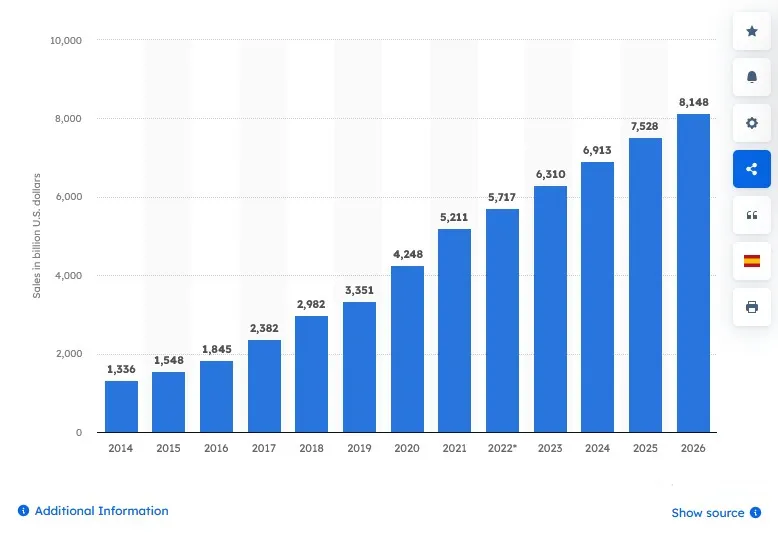
By 2027, analysts anticipate online sales to surpass $7.9 trillion, accounting for 23% of all retail sales. 📈 This presents a challenging outlook for merchants, with higher competition and greater consumer expectations. To stay ahead, start preparing your e-commerce strategies today with a trusted partner like Proximate Solutions. 💼
Businesses can enhance customer experiences and maximize conversions by focusing on these Four trends:
Make your site the obvious answer in Google and AI tools like Perplexity and ChatGPT.
Proximate Solutions will audit your site and deliver a simple plan you can act on immediately.
What you get (no cost, no commitment):Claim Your Custom AI Visibility & Growth Blueprint
Yes, I Want My Free Blueprint →

Online stores have significant growth potential this year. Here’s why you should invest now:
Gen Z and Millennials, being tech-savvy, are redefining online shopping habits. The Gen Z population is set to grow from 45.5 million in 2023 to 61.1 million by 2027, bringing dramatic changes to the industry.
These generations are not just shoppers; they are also influencers, shaping the market with their unique online habits and technological expertise.
Looking ahead, these key trends will impact how businesses engage with consumers:
Customer Experience (CX) is crucial for e-commerce success. McKinsey research shows companies excelling in CX see double the revenue growth. To improve CX:

As we approach 2025, the e-commerce landscape is primed for innovation and growth. Businesses that prioritize technological advancements, sustainability, and customer-centric solutions will thrive in this evolving market.
Start your journey toward success with Proximate Solutions and make 2025 your most prosperous year yet!
1- What are the dominant e-commerce trends shaping the industry?
The most impactful trends driving modern e-commerce include hyper-personalized AI shopping experiences, social commerce ecosystems, conversational voice search transactions, immersive augmented reality (AR) product trials, and privacy-first digital marketing frameworks.
2- How is artificial intelligence reshaping the e-commerce landscape?
AI fundamentally transforms the retail journey by powering predictive product recommendations, orchestrating automated customer care architectures, and engineering deeply customized, low-friction interactions across every consumer touchpoint.
3- What does the evolution of digital commerce look like?
The future of commerce centers on highly integrated, cross-platform experiences. Brands are building unified, frictionless customer journeys that transition seamlessly across web browsers, dedicated mobile applications, and emerging digital channels.
4- Why is individual personalization critical for e-commerce growth?
Tailoring content to specific user behaviors maximizes user engagement, lifts conversion rates, and fosters long-term brand equity by delivering highly relevant product assortments and contextual messaging exactly when the buyer needs it.
5- What exactly is social commerce?
Social commerce integrates product discovery and transactional checkout directly into social media networks. This enables consumers to complete full purchases without ever navigating away from their preferred social feeds, drastically reducing checkout friction.
6- What is driving the continuous expansion of mobile commerce?
Mobile commerce represents the vast majority of digital retail activity. This dominance is propelled by optimized mobile wallet integrations, native applications, and progressive web interfaces that offer unmatched on-the-go convenience.
7- What strategic role does augmented reality (AR) serve in retail?
AR acts as a powerful visualization tool, letting buyers digitally preview products—such as apparel, cosmetics, or home furnishings—within their physical environment before purchasing. This eliminates buyer uncertainty and actively drives down return rates.
8- What defines a true omnichannel e-commerce ecosystem?
An omnichannel model harmonizes a brand’s digital storefront, mobile application, social shopping channels, and physical retail locations into a single, cohesive ecosystem, ensuring uniform product availability, messaging, and data across all touchpoints.
9- How should enterprises position themselves to leverage emerging retail trends?
Organizations can future-proof their operations by embedding agile AI utilities into their tech stacks, optimizing cross-device user experiences, prioritizing zero-party data strategies for personalization, and migrating to highly secure, scalable cloud architectures.
10- What constitute the most significant headwinds facing digital merchants today?
The primary challenges center on navigating strict user data privacy regulations, overcoming saturated marketplace competition, and balancing the infrastructure demands of delivering ultra-fast delivery, bulletproof security, and tailored user interfaces.
By 2027, analysts anticipate online sales to surpass $7.9 trillion, accounting for 23% of all retail sales. 📈 This presents a challenging outlook for merchants, with higher competition and greater consumer expectations. To stay ahead, start preparing your e-commerce strategies today with a trusted partner like Proximate Solutions. 💼
Businesses can enhance customer experiences and maximize conversions by focusing on these Four trends:
Make your site the obvious answer in Google and AI tools like Perplexity and ChatGPT.
Proximate Solutions will audit your site and deliver a simple plan you can act on immediately.
What you get (no cost, no commitment):Claim Your Custom AI Visibility & Growth Blueprint
Yes, I Want My Free Blueprint →
Online stores have significant growth potential this year. Here’s why you should invest now:
Gen Z and Millennials, being tech-savvy, are redefining online shopping habits. The Gen Z population is set to grow from 45.5 million in 2023 to 61.1 million by 2027, bringing dramatic changes to the industry.
These generations are not just shoppers; they are also influencers, shaping the market with their unique online habits and technological expertise.
Looking ahead, these key trends will impact how businesses engage with consumers:
Customer Experience (CX) is crucial for e-commerce success. McKinsey research shows companies excelling in CX see double the revenue growth. To improve CX:
As we approach 2025, the e-commerce landscape is primed for innovation and growth. Businesses that prioritize technological advancements, sustainability, and customer-centric solutions will thrive in this evolving market.
Start your journey toward success with Proximate Solutions and make 2025 your most prosperous year yet!
1- What are the dominant e-commerce trends shaping the industry?
The most impactful trends driving modern e-commerce include hyper-personalized AI shopping experiences, social commerce ecosystems, conversational voice search transactions, immersive augmented reality (AR) product trials, and privacy-first digital marketing frameworks.
2- How is artificial intelligence reshaping the e-commerce landscape?
AI fundamentally transforms the retail journey by powering predictive product recommendations, orchestrating automated customer care architectures, and engineering deeply customized, low-friction interactions across every consumer touchpoint.
3- What does the evolution of digital commerce look like?
The future of commerce centers on highly integrated, cross-platform experiences. Brands are building unified, frictionless customer journeys that transition seamlessly across web browsers, dedicated mobile applications, and emerging digital channels.
4- Why is individual personalization critical for e-commerce growth?
Tailoring content to specific user behaviors maximizes user engagement, lifts conversion rates, and fosters long-term brand equity by delivering highly relevant product assortments and contextual messaging exactly when the buyer needs it.
5- What exactly is social commerce?
Social commerce integrates product discovery and transactional checkout directly into social media networks. This enables consumers to complete full purchases without ever navigating away from their preferred social feeds, drastically reducing checkout friction.
6- What is driving the continuous expansion of mobile commerce?
Mobile commerce represents the vast majority of digital retail activity. This dominance is propelled by optimized mobile wallet integrations, native applications, and progressive web interfaces that offer unmatched on-the-go convenience.
7- What strategic role does augmented reality (AR) serve in retail?
AR acts as a powerful visualization tool, letting buyers digitally preview products—such as apparel, cosmetics, or home furnishings—within their physical environment before purchasing. This eliminates buyer uncertainty and actively drives down return rates.
8- What defines a true omnichannel e-commerce ecosystem?
An omnichannel model harmonizes a brand’s digital storefront, mobile application, social shopping channels, and physical retail locations into a single, cohesive ecosystem, ensuring uniform product availability, messaging, and data across all touchpoints.
9- How should enterprises position themselves to leverage emerging retail trends?
Organizations can future-proof their operations by embedding agile AI utilities into their tech stacks, optimizing cross-device user experiences, prioritizing zero-party data strategies for personalization, and migrating to highly secure, scalable cloud architectures.
10- What constitute the most significant headwinds facing digital merchants today?
The primary challenges center on navigating strict user data privacy regulations, overcoming saturated marketplace competition, and balancing the infrastructure demands of delivering ultra-fast delivery, bulletproof security, and tailored user interfaces.