
The digital landscape is the second name of constantly evolving, and every business is always searching continuously to enhance its user experience. The innovation that has gained traction in recent years is Progressive Web Apps (PWAs). These apps are transforming the way we interact with web and mobile applications by combining the best features of both. If you are wondering what PWAs are and want to get a little deeper into the concept, Relax! At Proximate Solutions, we have outlined every necessary detail in the blog that you need to know about Progressive Web Apps.
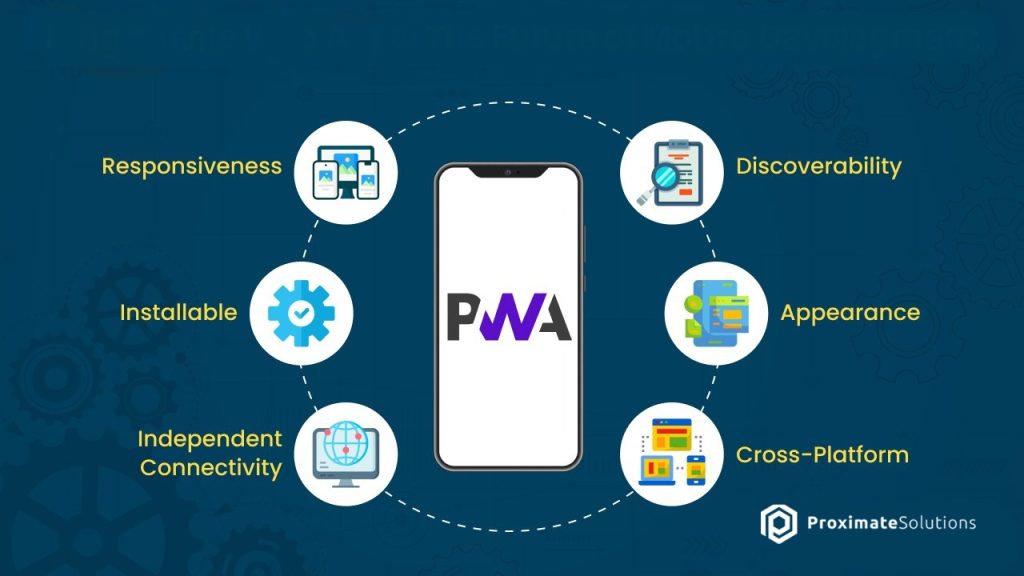
These web applications leverage modern web technologies to deliver users a fast, engaging, and app-like experience. PWAs are not like traditional websites that do not offer offline functionality. These web apps provide offline functionality, push notifications, and installability while maintaining the accessibility of a web page. Progressive web apps come with some exceptional features that make them stand out:
The increasing mobile usage trend makes businesses explore methods to give users smooth and fast user experiences. Progressive Web Apps (PWAs) provide businesses with powerful alternatives to native mobile apps due to their ability to unite key web applications and native mobile characteristics. PWAs offer instant access, offline operation with push alerts, and multiplatform functionality while overcoming the strength barriers of high project prices and app store dependency. PWA’s possess many benefits; let’s explore each one by one:
PWAs function apart from native apps because they let users reach content through any internet browser without needing app distribution platforms like Google Play or Apple App Store. The platform eradicates issues related to app store procedures, extended review periods, and expensive listing expenses.
Business updates can reach users instantly since they do not need to wait for app store review, resulting in faster application launch and deployments. PWAs help companies cut down costs on in-app purchase commissions, which is why Spotify launched its PWA to deliver user subscriptions without Apple’s payment fees.
The optimization for speed and performance in PWAs results in faster load times compared to standard websites and native apps. The utilization of service workers enables PWAs to store essential files before delivering content quickly, regardless of network status. Optimized assets ensure minimal data usage and smooth functionality, even on lower-end devices.
Make your site the obvious answer in Google and AI tools like Perplexity and ChatGPT.
Proximate Solutions will audit your site and deliver a simple plan you can act on immediately.
What you get (no cost, no commitment):Claim Your Custom AI Visibility & Growth Blueprint
Yes, I Want My Free Blueprint →

The Twitter Lite application reduced loading times by 75% while generating a 60% boost in session page views together with a 20% reduction in page bouncing. The speed at which PWAs load content enhances user retention and boosts engagement, drives businesses to choose PWAs over other options.
The most significant benefit of using PWAs stems from their offline functionality and ability to operate properly, even during weak network signals. Service workers in PWAs enable users to view previously cached pages even when the system lacks internet connectivity. PWAs deliver an essential advantage to users who handle restricted internet access environments. Through its PWA implementation, Starbucks lets users access menus and choose custom orders offline while providing uninterrupted service.
The ordering system immediately proceeds with the order after users connect to the internet. PWAs represent an ideal solution for people with restricted data plans because they use less data compared to standard mobile applications.
PWAs deliver the same functionality as native applications when it comes to sending notifications to users, which keeps them actively engaged. Push notifications are crucial for business as they allow firms to reconnect with their audience and deliver target-oriented deals and essential platform notices. Research shows that push notification systems help users stay active while increasing retention levels.
The PWA implementation from Pinterest resulted in a 60% increase in user engagement because platform users spent 40% more time on the platform than on the mobile website. PWAs provide businesses with a strong marketing platform through their capability to act as professional apps that simplify the native app installation process
PWAs represent a browser-ready digital solution because users can access them immediately and can add them to their home screen with one click. They occupy small storage space, making them appropriate for users who resist downloading significant apps. The easy installation process enables better user adoption by eliminating any required setup steps. The customer conversion rate at Flipkart Lite grew by 70% because of its quick access method.
These applications are deployable to all devices regardless of operating system, leading to one-stop development of iOS and Android applications. User experience maintains constant consistency because PWAs use one unified codebase that operates on smartphones as well as tablets and desktops. The development expenses decrease, and maintenance operations become simpler. Uber PWA illustrates the accessibility benefits of PWAs when users can book rides on low-end devices and slow networks. It demonstrates how PWAs enhance accessibility across different platforms.
The automatic background updating mechanism in PWAs means users avoid the inconvenience of manual download procedures that exist with native apps. Using this feature keeps users constantly updated with the newest versions while avoiding any service disruptions. Businesses can deploy bug fixes and implement new features to users. The PWA from Forbes displays new content in real-time which prevents users from needing refreshes or additional content downloads.
Organizations face high expenses and extended time needs when they create individual applications for both the iOS and Android platforms. PWAs serve as a solution since businesses create one universal application that operates properly across every platform. The investment of resources decreases significantly combined with minimized maintenance expenses to deliver a smooth user experience to all platform holders.
The AliExpress Progressive Web App reduced expenses and brought about a 104% increase in conversions to demonstrate that PWAs act as economical native app replacements.
PWAs are becoming the go-to choice for businesses with increasing mobile usage and demand for fast, engaging, and accessible experiences. PWAs are becoming compelling alternative to traditional mobile apps because they reduce development costs, improve performance, and enhance user engagement. Although there are some limitations like Bluetooth access and advanced hardware interactions, are better supported by native apps. However, advancement in technologies are rapidly bridging these gaps.
If you are running the business and wish to improve your digital presence, consider investing in a PWA. It might just be the game changer you need!
1- What exactly are Progressive Web Apps (PWAs)?
Progressive Web Apps are advanced web applications built with modern web development frameworks that mimic the user experience of a native mobile app while remaining accessible through a standard web browser.
2- How do PWAs operate under the hood?
PWAs leverage modern browser capabilities, specifically utilizing service workers (scripts running in the background) and smart caching strategies to deliver rapid load speeds, low-latency performance, and offline accessibility.
3- What are the primary advantages of deploying a Progressive Web App?
PWAs provide superior loading performance, offline capability, push notification support, and an intuitive user interface, all while requiring significantly lower development and maintenance capital expenditures compared to native mobile applications.
4- Are PWAs a superior alternative to native mobile applications?
PWAs are significantly more cost-effective to develop and easier to update globally from a single codebase, whereas native apps occasionally offer tighter integration with specialized hardware. The optimal selection hinges entirely on your specific business requirements and functional scope.
5- Do PWAs maintain functionality when a user is offline?
Yes. By relying on pre-cached application shell architecture and background service workers, PWAs remain functional during network blackouts or in extremely low-connectivity environments by serving cached data.
6- Are Progressive Web Apps compatible with search engine optimization (SEO)?
Absolutely. Because PWAs are fundamentally built as web pages, they possess standard web URLs. This allows search engine web crawlers to seamlessly crawl, index, and rank them, unlike standalone native applications.
7- Can users install PWAs directly onto their mobile devices?
Yes. Visitors can add a PWA directly onto their device’s home screen straight from their mobile browser, bypassing traditional app stores entirely and drastically lowering user download friction.
8- Why should modern enterprises consider adopting a PWA framework?
Businesses deploy PWAs to significantly drive up user engagement metrics, lower shopping cart abandonment rates, maximize digital conversion pipelines, and deliver a uniform cross-platform user experience across desktop and mobile devices.
The digital landscape is the second name of constantly evolving, and every business is always searching continuously to enhance its user experience. The innovation that has gained traction in recent years is Progressive Web Apps (PWAs). These apps are transforming the way we interact with web and mobile applications by combining the best features of both. If you are wondering what PWAs are and want to get a little deeper into the concept, Relax! At Proximate Solutions, we have outlined every necessary detail in the blog that you need to know about Progressive Web Apps.
These web applications leverage modern web technologies to deliver users a fast, engaging, and app-like experience. PWAs are not like traditional websites that do not offer offline functionality. These web apps provide offline functionality, push notifications, and installability while maintaining the accessibility of a web page. Progressive web apps come with some exceptional features that make them stand out:
The increasing mobile usage trend makes businesses explore methods to give users smooth and fast user experiences. Progressive Web Apps (PWAs) provide businesses with powerful alternatives to native mobile apps due to their ability to unite key web applications and native mobile characteristics. PWAs offer instant access, offline operation with push alerts, and multiplatform functionality while overcoming the strength barriers of high project prices and app store dependency. PWA’s possess many benefits; let’s explore each one by one:
PWAs function apart from native apps because they let users reach content through any internet browser without needing app distribution platforms like Google Play or Apple App Store. The platform eradicates issues related to app store procedures, extended review periods, and expensive listing expenses.
Business updates can reach users instantly since they do not need to wait for app store review, resulting in faster application launch and deployments. PWAs help companies cut down costs on in-app purchase commissions, which is why Spotify launched its PWA to deliver user subscriptions without Apple’s payment fees.
The optimization for speed and performance in PWAs results in faster load times compared to standard websites and native apps. The utilization of service workers enables PWAs to store essential files before delivering content quickly, regardless of network status. Optimized assets ensure minimal data usage and smooth functionality, even on lower-end devices.
Make your site the obvious answer in Google and AI tools like Perplexity and ChatGPT.
Proximate Solutions will audit your site and deliver a simple plan you can act on immediately.
What you get (no cost, no commitment):Claim Your Custom AI Visibility & Growth Blueprint
Yes, I Want My Free Blueprint →
The Twitter Lite application reduced loading times by 75% while generating a 60% boost in session page views together with a 20% reduction in page bouncing. The speed at which PWAs load content enhances user retention and boosts engagement, drives businesses to choose PWAs over other options.
The most significant benefit of using PWAs stems from their offline functionality and ability to operate properly, even during weak network signals. Service workers in PWAs enable users to view previously cached pages even when the system lacks internet connectivity. PWAs deliver an essential advantage to users who handle restricted internet access environments. Through its PWA implementation, Starbucks lets users access menus and choose custom orders offline while providing uninterrupted service.
The ordering system immediately proceeds with the order after users connect to the internet. PWAs represent an ideal solution for people with restricted data plans because they use less data compared to standard mobile applications.
PWAs deliver the same functionality as native applications when it comes to sending notifications to users, which keeps them actively engaged. Push notifications are crucial for business as they allow firms to reconnect with their audience and deliver target-oriented deals and essential platform notices. Research shows that push notification systems help users stay active while increasing retention levels.
The PWA implementation from Pinterest resulted in a 60% increase in user engagement because platform users spent 40% more time on the platform than on the mobile website. PWAs provide businesses with a strong marketing platform through their capability to act as professional apps that simplify the native app installation process
PWAs represent a browser-ready digital solution because users can access them immediately and can add them to their home screen with one click. They occupy small storage space, making them appropriate for users who resist downloading significant apps. The easy installation process enables better user adoption by eliminating any required setup steps. The customer conversion rate at Flipkart Lite grew by 70% because of its quick access method.
These applications are deployable to all devices regardless of operating system, leading to one-stop development of iOS and Android applications. User experience maintains constant consistency because PWAs use one unified codebase that operates on smartphones as well as tablets and desktops. The development expenses decrease, and maintenance operations become simpler. Uber PWA illustrates the accessibility benefits of PWAs when users can book rides on low-end devices and slow networks. It demonstrates how PWAs enhance accessibility across different platforms.
The automatic background updating mechanism in PWAs means users avoid the inconvenience of manual download procedures that exist with native apps. Using this feature keeps users constantly updated with the newest versions while avoiding any service disruptions. Businesses can deploy bug fixes and implement new features to users. The PWA from Forbes displays new content in real-time which prevents users from needing refreshes or additional content downloads.
Organizations face high expenses and extended time needs when they create individual applications for both the iOS and Android platforms. PWAs serve as a solution since businesses create one universal application that operates properly across every platform. The investment of resources decreases significantly combined with minimized maintenance expenses to deliver a smooth user experience to all platform holders.
The AliExpress Progressive Web App reduced expenses and brought about a 104% increase in conversions to demonstrate that PWAs act as economical native app replacements.
PWAs are becoming the go-to choice for businesses with increasing mobile usage and demand for fast, engaging, and accessible experiences. PWAs are becoming compelling alternative to traditional mobile apps because they reduce development costs, improve performance, and enhance user engagement. Although there are some limitations like Bluetooth access and advanced hardware interactions, are better supported by native apps. However, advancement in technologies are rapidly bridging these gaps.
If you are running the business and wish to improve your digital presence, consider investing in a PWA. It might just be the game changer you need!
1- What exactly are Progressive Web Apps (PWAs)?
Progressive Web Apps are advanced web applications built with modern web development frameworks that mimic the user experience of a native mobile app while remaining accessible through a standard web browser.
2- How do PWAs operate under the hood?
PWAs leverage modern browser capabilities, specifically utilizing service workers (scripts running in the background) and smart caching strategies to deliver rapid load speeds, low-latency performance, and offline accessibility.
3- What are the primary advantages of deploying a Progressive Web App?
PWAs provide superior loading performance, offline capability, push notification support, and an intuitive user interface, all while requiring significantly lower development and maintenance capital expenditures compared to native mobile applications.
4- Are PWAs a superior alternative to native mobile applications?
PWAs are significantly more cost-effective to develop and easier to update globally from a single codebase, whereas native apps occasionally offer tighter integration with specialized hardware. The optimal selection hinges entirely on your specific business requirements and functional scope.
5- Do PWAs maintain functionality when a user is offline?
Yes. By relying on pre-cached application shell architecture and background service workers, PWAs remain functional during network blackouts or in extremely low-connectivity environments by serving cached data.
6- Are Progressive Web Apps compatible with search engine optimization (SEO)?
Absolutely. Because PWAs are fundamentally built as web pages, they possess standard web URLs. This allows search engine web crawlers to seamlessly crawl, index, and rank them, unlike standalone native applications.
7- Can users install PWAs directly onto their mobile devices?
Yes. Visitors can add a PWA directly onto their device’s home screen straight from their mobile browser, bypassing traditional app stores entirely and drastically lowering user download friction.
8- Why should modern enterprises consider adopting a PWA framework?
Businesses deploy PWAs to significantly drive up user engagement metrics, lower shopping cart abandonment rates, maximize digital conversion pipelines, and deliver a uniform cross-platform user experience across desktop and mobile devices.