When you start a paid ad campaign, you might spend hours picking the right keywords and writing the perfect ad text. While those things are important, they are only the beginning. The moment someone clicks your ad, the focus shifts to your website.
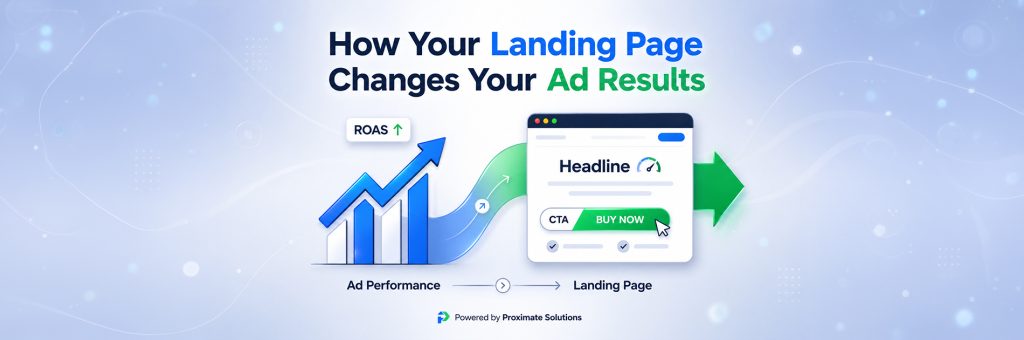
At Proximate Solutions, we have seen many businesses lose money because their ads are great, but their landing pages are not ready. If you want to know how landing pages affect ad performance, you have to look at the math and the user journey.
Google wants to show people the best content. To do this, they give every ad a score. If your landing page is helpful and fast, your score goes up. If your page is confusing or slow, your score goes down.
When your score is low, Google makes you pay more for every click. This means you could be paying $5.00 for a click that your competitor is getting for $2.00, just because their page is better. By fixing your page, you can actually lower your bills.
Make your site the obvious answer in Google and AI tools like Perplexity and ChatGPT.
Proximate Solutions will audit your site and deliver a simple plan you can act on immediately.
What you get (no cost, no commitment):Claim Your Custom AI Visibility & Growth Blueprint
Yes, I Want My Free Blueprint →

To get the best results, your page needs to follow a few simple rules. At Proximate Solutions, we tell our clients to focus on these four areas:
In the USA, people do not like to wait. If your page takes more than two or three seconds to load, most people will click the “back” button. When people leave your site quickly, it tells Google that your page is not good. This is called a “bounce.” High bounce rates lead to poor ad performance. You need a site that loads fast on both phones and computers.
If your ad says “Cheap Red Shoes,” but your landing page shows “Expensive Blue Boots,” people will leave. This is called a lack of “relevance.” Your landing page must match the promise of your ad. Use the same words and show the same products. This makes the user feel like they are in the right place.
Do not clutter your page with too many images or long blocks of text. Use simple words. Tell the user exactly what to do next. Do you want them to call you? Put a big button at the top. Do you want them to buy a product? Put the “Buy Now” button where they can see it without scrolling.
Most people in the USA click ads on their phones. If your page looks good on a laptop but is hard to use on a phone, your ad performance will suffer. Make sure buttons are easy to tap and text is large enough to read on a small screen.
People are careful about where they spend their money. If your site looks old or “spammy,” they won’t buy from you. Proximate Solutions recommends adding things like:
These small details help your “Landing Page Experience” score and help turn clicks into sales.
You should always look at your data. Check your “Conversion Rate.” This tells you what percentage of people who clicked your ad actually did what you wanted them to do. If your conversion rate is low, it is usually a sign that your landing page needs work.
Changing a few words or moving a button might seem small, but it can lead to a huge jump in your profits. You don’t need a complex website to win; you just need a site that is clear, fast, and honest.
We believe that digital marketing is a full circle. You cannot have a successful ad without a strong destination. When we help brands with their ads, we always look at the landing page first. It is the foundation of your success. If the foundation is weak, the whole campaign will fall.
By focusing on how landing pages affect ad performance, you take control of your budget. You stop guessing and start growing. Remember, the goal of an ad is to get a click, but the goal of a landing page is to get a customer.
1- Does my landing page impact my Google Ads Quality Score?
Yes. The experience visitors have on your landing page is a critical factor Google evaluates to determine your Quality Score. Optimizing your page raises this score and decreases your overall ad costs.
2- Can a slow landing page cause my ads to stop displaying?
If your page takes too long to load, your Quality Score can plummet. This can cause Google to stop displaying your ads altogether, or force you to pay significantly higher bid prices just to maintain your visibility.
3- What counts as a strong conversion rate for a landing page?
Though benchmarks change depending on your sector, an average conversion rate typically ranges from 2% to 5%. If your conversion rate falls under 1%, it usually indicates an issue with your page layout, load speed, or core messaging.
4- Should I create a separate landing page for every single ad?
Not necessarily, though higher personalization yields better results. Aligning your page closely with your ad copy boosts performance. At Proximate Solutions, we recommend building targeted pages for your highest-value keywords.
5- How much copy should I include on my landing page?
Only include the amount of text required to address user intent and establish credibility. Excess text can overwhelm visitors, so keep your messaging concise and utilize clear bullet points.
6- Is the “Above the Fold” section genuinely important?
Yes. The “above the fold” area is the initial view a user sees before scrolling. To capture attention immediately, your primary value proposition and main call-to-action button must sit in this space.
7- Can I just use my website’s homepage as my landing page?
Generally, no. A standard homepage contains too many navigation links and distractions. A dedicated landing page is built around a single, focused objective and guides the user down a single path.
When you start a paid ad campaign, you might spend hours picking the right keywords and writing the perfect ad text. While those things are important, they are only the beginning. The moment someone clicks your ad, the focus shifts to your website.
At Proximate Solutions, we have seen many businesses lose money because their ads are great, but their landing pages are not ready. If you want to know how landing pages affect ad performance, you have to look at the math and the user journey.
Google wants to show people the best content. To do this, they give every ad a score. If your landing page is helpful and fast, your score goes up. If your page is confusing or slow, your score goes down.
When your score is low, Google makes you pay more for every click. This means you could be paying $5.00 for a click that your competitor is getting for $2.00, just because their page is better. By fixing your page, you can actually lower your bills.
Make your site the obvious answer in Google and AI tools like Perplexity and ChatGPT.
Proximate Solutions will audit your site and deliver a simple plan you can act on immediately.
What you get (no cost, no commitment):Claim Your Custom AI Visibility & Growth Blueprint
Yes, I Want My Free Blueprint →
To get the best results, your page needs to follow a few simple rules. At Proximate Solutions, we tell our clients to focus on these four areas:
In the USA, people do not like to wait. If your page takes more than two or three seconds to load, most people will click the “back” button. When people leave your site quickly, it tells Google that your page is not good. This is called a “bounce.” High bounce rates lead to poor ad performance. You need a site that loads fast on both phones and computers.
If your ad says “Cheap Red Shoes,” but your landing page shows “Expensive Blue Boots,” people will leave. This is called a lack of “relevance.” Your landing page must match the promise of your ad. Use the same words and show the same products. This makes the user feel like they are in the right place.
Do not clutter your page with too many images or long blocks of text. Use simple words. Tell the user exactly what to do next. Do you want them to call you? Put a big button at the top. Do you want them to buy a product? Put the “Buy Now” button where they can see it without scrolling.
Most people in the USA click ads on their phones. If your page looks good on a laptop but is hard to use on a phone, your ad performance will suffer. Make sure buttons are easy to tap and text is large enough to read on a small screen.
People are careful about where they spend their money. If your site looks old or “spammy,” they won’t buy from you. Proximate Solutions recommends adding things like:
These small details help your “Landing Page Experience” score and help turn clicks into sales.
You should always look at your data. Check your “Conversion Rate.” This tells you what percentage of people who clicked your ad actually did what you wanted them to do. If your conversion rate is low, it is usually a sign that your landing page needs work.
Changing a few words or moving a button might seem small, but it can lead to a huge jump in your profits. You don’t need a complex website to win; you just need a site that is clear, fast, and honest.
We believe that digital marketing is a full circle. You cannot have a successful ad without a strong destination. When we help brands with their ads, we always look at the landing page first. It is the foundation of your success. If the foundation is weak, the whole campaign will fall.
By focusing on how landing pages affect ad performance, you take control of your budget. You stop guessing and start growing. Remember, the goal of an ad is to get a click, but the goal of a landing page is to get a customer.
1- Does my landing page impact my Google Ads Quality Score?
Yes. The experience visitors have on your landing page is a critical factor Google evaluates to determine your Quality Score. Optimizing your page raises this score and decreases your overall ad costs.
2- Can a slow landing page cause my ads to stop displaying?
If your page takes too long to load, your Quality Score can plummet. This can cause Google to stop displaying your ads altogether, or force you to pay significantly higher bid prices just to maintain your visibility.
3- What counts as a strong conversion rate for a landing page?
Though benchmarks change depending on your sector, an average conversion rate typically ranges from 2% to 5%. If your conversion rate falls under 1%, it usually indicates an issue with your page layout, load speed, or core messaging.
4- Should I create a separate landing page for every single ad?
Not necessarily, though higher personalization yields better results. Aligning your page closely with your ad copy boosts performance. At Proximate Solutions, we recommend building targeted pages for your highest-value keywords.
5- How much copy should I include on my landing page?
Only include the amount of text required to address user intent and establish credibility. Excess text can overwhelm visitors, so keep your messaging concise and utilize clear bullet points.
6- Is the “Above the Fold” section genuinely important?
Yes. The “above the fold” area is the initial view a user sees before scrolling. To capture attention immediately, your primary value proposition and main call-to-action button must sit in this space.
7- Can I just use my website’s homepage as my landing page?
Generally, no. A standard homepage contains too many navigation links and distractions. A dedicated landing page is built around a single, focused objective and guides the user down a single path.